Your Complete Guide to
Spousal Maintenance in Washington State

Professional portrait of mediator Joe Dillon seated at a conference table with a warm, reassuring smile, ready to guide you through an amicable divorce process. For compassionate support, call Equitable Mediation at (877) 732-6682 today.

If you’re contemplating divorce in Washington State, questions about spousal maintenance are probably keeping you up at night. Will I have to pay support? Will I receive it? How much, and for how long? These aren’t just financial questions—they’re questions about your future security and independence.

The good news is that you don’t need to navigate these decisions in an adversarial courtroom setting. Most couples find that understanding Washington’s maintenance framework and working through these issues cooperatively in mediation leads to agreements that work better for everyone involved.

How Does Spousal Maintenance Work in Washington State, and Is It Different From Alimony?

You’ll hear different terms thrown around—alimony, spousal support, maintenance—and it can be confusing. In Washington, we use the term “spousal maintenance,” and it operates differently than what you might have heard about in other states.

Washington is a community property state, which fundamentally changes how maintenance works. Unlike in separate property states, where the focus is often on compensating one spouse for contributions to the other’s career, Washington’s approach recognizes that marriage is an economic partnership in which both spouses’ contributions matter equally.

Most importantly, maintenance isn’t about punishment or reward—it’s about helping both spouses transition to financial independence after divorce. Understanding the factors that come into play in Washington gives you a framework for productive conversations rather than adversarial battles.

What’s the Difference Between Temporary Maintenance During Divorce and Long-Term Spousal Support in Washington?

When you’re going through a divorce, you’re actually dealing with two different types of financial support, and understanding the distinction matters for planning purposes.

Temporary maintenance—what’s called maintenance pendente lite—addresses the financial imbalance that often exists while your divorce is pending. Maybe one spouse has moved out and is paying for two households. This temporary support doesn’t predict what your long-term arrangement will look like.

Post-decree maintenance is what you’ll live with after your divorce is final. It’s based on a different analysis and considers your post-divorce financial reality, not just the status quo during your marriage. Understanding the two-phase nature of support helps you approach each phase strategically in mediation rather than getting overwhelmed by trying to solve everything at once.

How Do Washington Courts Decide How Much Spousal Maintenance to Award, and What Financial Information Do I Need to Gather?
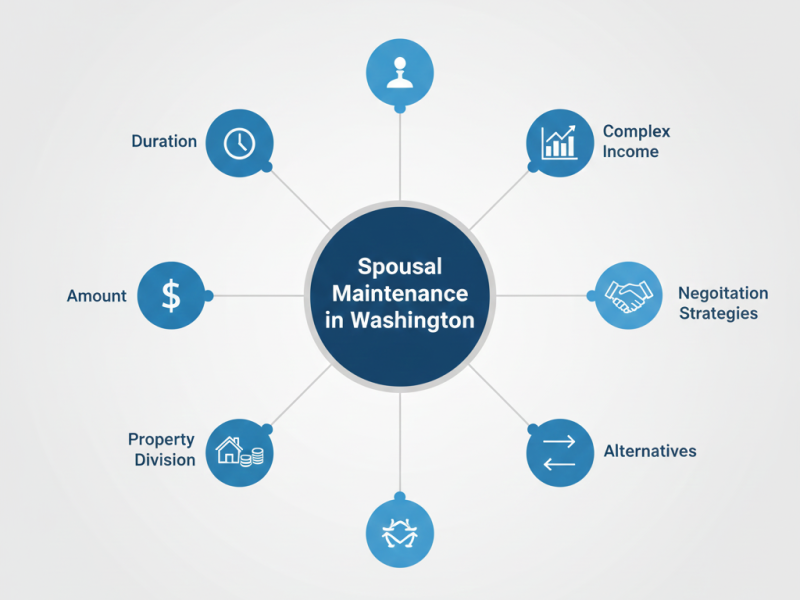
Reviewing Washington spousal maintenance factors such as income, earning capacity, marital lifestyle, and financial resources to determine fair support through Equitable Mediation. Call (877) 732-6682 to discuss your options.

The question everyone asks first is “how much?” But before you can answer that, you need to understand what factors get considered in Washington and how to analyze your own situation thoroughly.

Factors that come into play include the duration of your marriage, each spouse’s financial resources and earning capacity, the standard of living during the marriage, age and health, and the time needed for education or training. But there’s no formula or calculator that spits out a maintenance amount—which means you have flexibility in mediation to design arrangements that actually fit your circumstances.

Here’s what matters most for mediation: understanding how to project your post-divorce budget realistically. This means looking at your actual expenses, analyzing all income streams (including business income, bonuses, stock compensation if relevant), considering tax implications, and thinking about how property division intersects with maintenance.

With my MBA in finance and nearly 20 years of experience, I help couples work through this financial analysis systematically. We don’t just look at what you think you need—we examine your actual spending patterns, identify hidden costs that emerge when one household becomes two, and model different maintenance scenarios to see their real-world impact on both spouses’ financial stability.

How Does Community Property Division Affect Spousal Maintenance in Washington, and Should I Negotiate Them Together or Separately?

One of the most common mistakes divorcing couples make is treating property division and maintenance as entirely separate issues. In Washington, these two components are deeply interrelated, and understanding their connection is crucial for reaching an agreement that actually works.

Here’s why it matters: if you receive a larger share of community property, that affects your maintenance needs. If one spouse is keeping a business or retirement accounts, that impacts the overall financial picture. How property division happens in Washington directly influences maintenance analysis.

The question isn’t just whether to negotiate them together—it’s how to approach them holistically so you’re making strategic decisions about your complete financial picture. This includes thinking about tradeoffs like accepting less maintenance in exchange for keeping the house, or structuring higher maintenance but taking fewer assets for immediate liquidity.

Every couple’s situation is unique, and that’s why we don’t believe in one-size-fits-all processes. Instead, we develop a personalized approach that examines your specific asset composition, income situation, and financial needs to design solutions tailored to your circumstances rather than forcing you into generic templates.

What Happens to Spousal Maintenance Calculations When One Spouse Owns a Business or Has Complex Income in Washington?

If you or your spouse owns a business, receives bonuses or commissions, has rental properties, or has any income beyond a straightforward W-2, maintenance calculations become significantly more complex.

The challenge with business income is distinguishing between what the business reports for tax purposes and what’s actually available for support. Business owners legitimately reduce their taxable income through depreciation and business expenses—but that doesn’t mean the money isn’t there. What gets analyzed is cash flow, not just reported income.

You’ll also need to understand whether the business is community property, separate property, or a mix of both, and how to have productive conversations about business income in mediation without getting stuck in accusations of hiding income or unrealistic expectations about what’s available.

When your earnings involve bonuses, stock options, RSUs, or equity shares, it can be hard to see a clear way forward. With my background in finance, I can cut through the thicket of financial complexity, helping you understand what income is truly available for support while protecting what you’ve built. This expertise in handling complex compensation structures makes an enormous difference in reaching fair agreements that both spouses can live with.

How Long Does Spousal Maintenance Last in Washington, and What Factors Influence the Duration?

Amount and duration are separate questions, but they’re equally important. You might agree on how much maintenance should be paid but disagree completely about how long it should continue.

How Washington approaches duration is based on several factors: the length of your marriage, the standard of living you established, age and health, and most importantly, the time reasonably necessary for the recipient spouse to become self-supporting. This reflects Washington’s underlying principle that maintenance should be transitional—it’s meant to help the lower-earning spouse adjust to financial independence, not to provide permanent support in most cases.

But how long is reasonable? A twenty-five-year marriage looks very different from a five-year marriage. A spouse who left the workforce to raise children needs different considerations than one who has always worked full-time. Understanding the factors that influence duration provides a framework for working through these questions in mediation.

This includes the concept of “rehabilitative maintenance” (support focused on specific education or training), when longer-term support might be appropriate, and how to build in flexibility for changing circumstances. We don’t just help you determine duration for today—we help you anticipate how circumstances might change down the road and build appropriate provisions into your agreement so you can move forward confidently without constantly looking back.

How Does the Marital Standard of Living Affect Spousal Maintenance Negotiations in Washington?

The standard of living you established during your marriage is one of the factors that gets considered in Washington, but it’s also one of the most emotionally charged aspects of maintenance negotiations.

Here’s the reality: maintaining the same standard of living across two separate households simply isn’t financially feasible for most couples. The money that supported one household now needs to support two households, with all the duplicated expenses that entail. For most families, something has to give.

This creates natural tension in negotiations. The lower-earning spouse often feels entitled to maintain the lifestyle they’re accustomed to. The higher-earning spouse may feel frustrated by what seems like unrealistic expectations. Both feelings are valid, but neither gets you to an agreement.

You need strategies for discussing lifestyle expectations realistically, documenting your actual standard of living objectively using bank statements and credit card records rather than assumptions, and having conversations about necessary lifestyle adjustments without blame or shame. I actively guide you through this process rather than leaving you to fight it out alone—bringing options to the table and helping you work through disagreements constructively.

What Should I Know About Spousal Maintenance in Washington If We Had a Short Marriage Versus a Long-Term Marriage?

Marriage length profoundly influences how maintenance gets approached—and how you should think about it too. A three-year marriage raises different considerations than a thirty-year marriage.

Short marriages (generally under five years) typically result in limited maintenance, if any. The reasoning is that neither spouse has developed significant economic interdependence or made long-term career sacrifices based on the marriage.

Long-term marriages (generally over twenty years) create different expectations. When spouses have been economically interdependent for decades, when one spouse has been out of the workforce for years, and when retirement is approaching, transitioning to complete financial independence may not be realistic. Indefinite maintenance becomes more common in these situations.

Understanding these differences helps you negotiate an agreement that reflects the realities of your situation, including how to approach conversations when you and your spouse have very different views about what marriage length should mean for maintenance obligations.

How Can I Negotiate a Fair Spousal Maintenance Agreement in Washington Without Going to Court?

Understanding the factors and conducting financial analysis are essential, but knowing how to negotiate an agreement—especially when emotions are running high, and you’re discussing money—is what determines whether you’ll reach a resolution through mediation or end up in expensive litigation.

Maintenance negotiations are inherently complex. One spouse is asking for money, and the other is being asked to provide it, often for years to come. It’s personal. It touches on feelings about fairness, contributions to the marriage, and fears about the future.

Effective mediation strategies specific to maintenance discussions can help you navigate these challenges. Consider options like step-down provisions (where maintenance decreases over time as the recipient spouse’s earning capacity increases), education or training support as an investment in future independence, or lump-sum settlements that provide closure and eliminate ongoing obligations.

The goal isn’t just reaching any agreement—it’s reaching an agreement both spouses can genuinely live with. That’s why I bring interest-based negotiation techniques, helping you move past rigid positions (“I demand $3,000 monthly”) to underlying interests (“I need financial security during my career transition”). This transforms adversarial bargaining into collaborative problem-solving.

Should I Consider Alternatives to Monthly Spousal Maintenance Payments in Washington, and What Are My Options?

Evaluating Washington spousal maintenance alternatives like lump-sum buyouts, property offsets, and customized payment structures with financial guidance from Equitable Mediation. Contact (877) 732-6682 for personalized support.

Most people assume maintenance means monthly checks continuing for years. But Washington gives you tremendous flexibility, and creative alternatives often work better for both spouses.

Lump-sum buyouts allow the paying spouse to make a single payment rather than ongoing monthly payments. This provides closure and eliminates future disputes, though it requires sophisticated present value calculations to ensure fairness.

Trading maintenance for additional property is another powerful option—perhaps the lower-earning spouse keeps the house or a larger share of retirement accounts in exchange for receiving reduced or no maintenance. This requires understanding the true economic equivalence between assets and income streams.

Rehabilitative support for specific education or training provides yet another structure. Instead of indefinite maintenance, the paying spouse supports the recipient through a degree program or career transition with a defined endpoint.

These creative structures require financial analysis to evaluate properly. With my finance background, I help couples compare lump-sum buyouts to periodic payments using present value calculations, understand tax implications of different structures (crucial since maintenance tax treatment changed in 2019), and model how different arrangements affect each spouse’s long-term financial security.

Moving Forward With Confidence and Expert Guidance

Using financial modeling, scenario projections, and tax analysis to plan sustainable Washington spousal maintenance outcomes with Equitable Mediation. Schedule a consultation at (877) 732-6682.

Spousal maintenance is just one piece of your divorce, but it’s often the piece that feels most overwhelming. The questions are complex, the stakes are high, and the emotions are intense. Where do you even start?

The answer begins with information. Understanding how Washington approaches maintenance, knowing which financial analyses you need to conduct, and learning to negotiate effectively gives you the foundation to make decisions with confidence rather than fear.

But information alone isn’t enough. You also need the right process—one that allows you to explore options, ask questions, and work through disagreements without turning your divorce into a war. That’s what mediation provides, especially when you work with a mediator who brings both deep financial expertise and advanced negotiation training.

Here’s what makes mediation with the right expertise so much more effective than litigation for spousal maintenance: In court, you’re stuck with rigid categories and judicial guidelines. Attorneys fight over extreme positions while a judge who spent a few hours reviewing your case makes decisions that will affect your financial life for years or decades. You lose control over the outcome, spend tens of thousands in legal fees on adversarial battles, and end up with a one-size-fits-all order that may not reflect your actual circumstances.

In mediation, you maintain control. You work through the financial analysis collaboratively rather than through dueling expert witnesses. With my MBA in finance and nearly 20 years of experience, I bring the analytical skills to help you understand the true economics of different maintenance structures—running present value calculations, modeling various scenarios, evaluating tax implications, and projecting how different arrangements affect both spouses’ financial security five years out, ten years out, and into retirement.

Exploring creative Washington spousal maintenance solutions such as step-down schedules, hybrid agreements, and property trades with expert mediation guidance. Speak with Equitable Mediation at (877) 732-6682.

But I don’t just provide analysis. I actively guide you through the negotiation process. We don’t require you to have all the answers or fight for every position. I bring options to the table you might never have considered—declining payment structures, milestone-based arrangements, property-maintenance trades, or hybrid approaches that blend different strategies. These creative solutions would be nearly impossible to achieve through litigation’s rigid process.

This approach is personalized to your specific situation. Every couple’s circumstances are unique, and we don’t believe in forcing you into generic formulas or one-size-fits-all templates. Whether you’re dealing with complex business income, tech company stock compensation, significant age differences, career sacrifices for child-rearing, or any other unique factors, we develop solutions tailored to your actual needs and circumstances.

We don’t just tackle the immediate challenges of determining maintenance amounts and duration. We help you anticipate how circumstances might change down the road—income changes, health issues, remarriage, retirement—and build appropriate flexibility into your agreement. This future-focused planning helps you move forward confidently without constantly looking back or worrying about future modification battles.

And critically, this process preserves important relationships rather than destroying them through adversarial litigation. The cooperative approach means you’re working together to find solutions serving both parties’ interests rather than fighting over rigid positions. If you have children, this cooperative foundation makes co-parenting dramatically easier. Even without children, ending your marriage through collaborative negotiation rather than bitter court battles allows both of you to move forward with less emotional damage, more dignity, and genuine hope for your respective futures.

With specialized training from Harvard, MIT, and Northwestern, combined with my MBA in finance, I bring both the negotiation expertise and financial analytical skills that transform what could be a devastating court battle into a manageable, collaborative process. You maintain control over decisions about your financial future, you design solutions that reflect your actual circumstances rather than fitting into rigid templates, and you protect both your financial resources and your most important relationships.

Your divorce doesn’t have to be adversarial. Your financial future doesn’t have to be uncertain. With the right information, the right process, and the right expertise guiding you, you can reach an agreement on spousal maintenance that allows both of you to move forward with security, dignity, and confidence that you’ve made informed decisions rather than ones driven by fear, anger, or incomplete understanding.

That’s the power of choosing mediation with deep financial expertise and advanced negotiation skills—creating better outcomes through collaboration while protecting what matters most and positioning both of you well for your respective futures.

“When you think about divorce, legal issues might come to mind first. However, three of the four main issues that need to be resolved during divorce are actually financial in nature (with parenting being the fourth).

This is why having a mediator with strong financial expertise can be particularly valuable in reaching a well-informed, sustainable agreement.”

Photo of mediator Joe Dillon at the center of the Equitable Mediation team, all smiling and poised around a conference table ready to assist. Looking for expert, compassionate divorce support? Call Equitable Mediation at (877) 732-6682 to connect with our dedicated team today.

Joe Dillon, MBA

| Divorce Mediator & Founder

FAQs About Spousal Maintenance in Washington State

Spousal maintenance is Washington State’s legal term for alimony or spousal support – financial payments one spouse makes to the other during or after divorce. While “alimony” and “spousal support” are common terms people use, Washington law specifically refers to these payments as “maintenance” under the Revised Code of Washington (RCW) 26.09.090. All three terms describe the same concept of financial assistance paid by one spouse to help the other maintain a reasonable standard of living following divorce.

The purpose of maintenance in Washington is to help equalize the parties’ standard of living for an appropriate period of time, recognizing that marriage is an economic partnership where one spouse may have sacrificed career opportunities, earning potential, or educational advancement to support the family or the other spouse’s career. Unlike child support which focuses on children’s needs, maintenance addresses the financial disparity between spouses and aims to provide the lower-earning spouse with support during the transition to financial independence.

Washington is a no-fault divorce state, meaning courts cannot consider marital misconduct such as infidelity or fault when determining whether to award maintenance. Instead, the court focuses entirely on financial factors and circumstances. Maintenance is not automatic in Washington divorces – the court must evaluate all relevant factors outlined in the statute before determining whether maintenance is appropriate, and if so, the amount and duration.

An important 2024 Washington Supreme Court decision clarified that while courts must consider a requesting spouse’s financial need among other factors, demonstrating need is not a prerequisite to receiving a maintenance award, giving courts broad discretion based on all circumstances of the case.

No, Washington State does not have a statutory formula or calculator to determine spousal maintenance amounts like some other states do. Instead, Washington law grants judges broad discretion to award maintenance in amounts and for periods they deem just after considering all relevant factors outlined in RCW 26.09.090. This lack of a rigid formula means maintenance awards are determined on a case-by-case basis according to each couple’s unique circumstances, making outcomes less predictable than in states with mathematical formulas.

However, family law practitioners and courts do follow general guidelines and norms based on the length of the marriage. For marriages of 5 years or less (short-term marriages), courts typically try to restore each spouse to the financial position they were in before marriage, often awarding minimal maintenance or only enough to help the lower-earning spouse meet basic needs for a few months while getting back on their feet financially.

For marriages of 25 years or longer (long-term marriages), the goal shifts to equalizing both spouses’ financial positions for the remainder of their lives, recognizing them as equal economic partners. This often results in substantial maintenance awards that last until retirement age or indefinitely.

For marriages between 5 and 25 years (mid-range marriages), there’s the greatest variability and unpredictability in awards. As a rough guideline, courts often award approximately one year of maintenance for every three to four years of marriage, though this is not a legal requirement and individual circumstances heavily influence actual awards. Another common guideline practitioners reference is that maintenance duration often equals about 25% of the marriage’s length, though again this is merely a general observation rather than a binding rule.

The amount of maintenance depends on numerous factors including the income disparity between spouses, the standard of living during marriage, each spouse’s financial resources and needs, ability to pay, age, health, and many other considerations. Because Washington lacks a formula, working with an experienced divorce attorney becomes especially important to understand the range of reasonable outcomes based on your specific circumstances and the practices of judges in your jurisdiction.

Washington State courts must consider six statutory factors outlined in RCW 26.09.090 when determining whether to award maintenance and, if so, how much and for how long. These factors are not ranked in order of importance, and courts have discretion to weigh them according to each case’s particular circumstances.

The first factor is the financial resources of the spouse seeking maintenance, including separate or community property awarded in the divorce and their ability to meet their needs independently. This includes considering whether property division provides sufficient income-producing assets to support the requesting spouse. The court also considers whether the requesting spouse receives child support that includes a sum for them as custodian.

The second factor is the time necessary for the spouse seeking maintenance to acquire sufficient education or training to enable them to find employment appropriate to their skills, interests, style of life, and other attendant circumstances. This recognizes that some spouses may need time to update skills, complete degrees, or obtain training to re-enter the workforce after years focusing on family responsibilities.

The third factor is the standard of living established during the marriage. Courts aim to help both spouses maintain a lifestyle reasonably comparable to what they enjoyed during the marriage, though this doesn’t mean guaranteeing identical standards of living for both parties.

The fourth factor is the duration of the marriage or domestic partnership. Longer marriages generally result in longer maintenance awards because the economic interdependence deepens over time and it becomes less realistic to expect complete financial independence.

The fifth factor encompasses the age, physical and emotional condition, and financial obligations of the spouse seeking maintenance. Older spouses or those with health issues limiting their earning capacity may receive longer or more substantial awards.

The sixth factor is the ability of the spouse from whom maintenance is sought to meet their own needs and financial obligations while meeting those of the spouse seeking maintenance. The court must ensure the paying spouse retains sufficient income to support themselves.

Importantly, Washington courts may also consider other relevant factors beyond these six statutory ones, including contributions to the other spouse’s education or career, sacrifices made during the marriage, and any other circumstances the court finds just and equitable. What courts cannot consider is marital misconduct – Washington’s no-fault divorce law prohibits considering which spouse wanted the divorce or behavior like infidelity when making maintenance decisions.

The duration of spousal maintenance in Washington State varies significantly based primarily on the length of the marriage, though no statute dictates specific timeframes. Courts categorize marriages into three general groups with different duration expectations.

For short-term marriages lasting 5 years or less, maintenance rarely extends beyond the entry of the divorce decree. When awarded at all, it typically lasts only a few months – just long enough to help the lower-earning spouse transition back to financial independence and return to their pre-marriage economic position. Courts view these marriages as brief partnerships where complete economic entanglement hasn’t fully developed.

For long-term marriages of 25 years or more, maintenance often continues for many years or even indefinitely until retirement age, the recipient’s remarriage, or either party’s death. In these marriages, courts recognize the spouses as equal economic partners where one may have sacrificed decades of career development to support the family, making complete financial independence unrealistic or impossible. The goal becomes equalizing both spouses’ financial positions for the remainder of their lives.

For mid-range marriages between 5 and 25 years, duration varies most widely and depends heavily on individual circumstances and judicial discretion. The commonly cited guideline suggests courts award approximately one year of maintenance for every three to four years of marriage. For example, a 12-year marriage might result in maintenance lasting 3 to 4 years. Another rough estimate is that maintenance lasts about 25% of the marriage’s length, so a 16-year marriage might result in 4 years of maintenance. However, these are merely general observations, not legal requirements, and actual awards can vary significantly.

Courts consider whether the requesting spouse can reasonably become self-supporting within a specific timeframe through education, training, or workforce re-entry. Maintenance intended to support a spouse while they gain skills for self-sufficiency is sometimes called rehabilitative maintenance.

Washington does not favor permanent or lifetime maintenance awards, but they may be appropriate when the recipient spouse is elderly, disabled, never worked outside the home during a very long marriage, has minimal marital assets, or faces other circumstances making self-support unrealistic. The maintenance order will specify whether it’s for a fixed term with a specific end date or indefinite, subject to modification based on substantial changes in circumstances.

No, demonstrating financial need is not a prerequisite to receiving spousal maintenance in Washington State, according to a landmark 2024 Washington Supreme Court decision in In re Marriage of Wilcox. This ruling clarified decades of confusion and corrected the widespread belief among attorneys and judges that maintenance required proving need.

Prior to the enactment of RCW 26.09.090, Washington law did require spouses to demonstrate financial need to receive alimony. However, when the legislature enacted the current maintenance statute with its six-factor framework, it changed this requirement. The Washington Supreme Court held that while trial courts must consider the requesting spouse’s need for support as one factor among others listed in RCW 26.09.090, establishing need is not a threshold requirement before awarding maintenance.

The statute’s plain language requires courts to consider all relevant factors, with financial need being just one consideration rather than a mandatory prerequisite. This means a spouse might receive maintenance even if they could technically meet their basic needs independently, particularly when other statutory factors weigh heavily in favor of an award.

For example, after a long marriage where one spouse sacrificed career advancement to support the family while the other spouse developed high earning potential, maintenance might be appropriate to equalize the parties’ standards of living even if the requesting spouse isn’t destitute. The court might award maintenance to recognize contributions to the other spouse’s career, to account for the standard of living established during a long marriage, or to address the reality that an older spouse cannot realistically build a career to match their former partner’s income.

The Wilcox decision reinforces that Washington’s maintenance law is intentionally flexible, granting trial courts broad discretion to fashion awards that are “just” based on the totality of circumstances rather than rigid rules about need. That said, financial need remains highly relevant and continues to be one of the primary considerations courts evaluate. The requesting spouse’s financial resources and ability to meet their needs independently, and the other spouse’s ability to pay while meeting their own obligations, are still central to most maintenance determinations. But need is now properly understood as one important factor among several, not an absolute requirement.

Washington State recognizes several types of spousal maintenance, each serving different purposes and timeframes, though they’re not formally categorized by statute. The most common is temporary maintenance, which provides financial support during the divorce process itself from the time spouses separate until the divorce is finalized. Because Washington divorces can take many months or even over a year to complete, temporary maintenance helps the lower-earning spouse meet living expenses while the case is pending. This type automatically ends when the divorce decree is entered.

Fixed-term or durational maintenance is awarded for a specific period after divorce with a definite end date stated in the decree. This is the most common type of post-divorce maintenance, used when the court determines the recipient spouse needs support for a set time period – perhaps while completing education, gaining work experience, or transitioning to financial independence. Once the specified term expires, the obligation ends unless the parties agreed otherwise or the court specifically made it subject to review.

Rehabilitative maintenance is a subset of fixed-term maintenance specifically intended to support a spouse while they acquire the education, training, or work experience necessary to become self-supporting. This recognizes that some spouses sacrificed career development during the marriage and need time and resources to re-enter the workforce at an appropriate level. The goal is enabling self-sufficiency, not long-term dependence.

Indefinite maintenance has no predetermined end date and continues until modified by the court based on substantial change in circumstances, the recipient’s remarriage, registration of a new domestic partnership, or either party’s death. While Washington does not favor permanent or lifetime maintenance, indefinite awards may be appropriate in long marriages where one spouse cannot realistically become self-supporting due to age, disability, lack of work history, or other factors. Indefinite doesn’t mean unmodifiable – either party can petition for modification if circumstances substantially change.

Parties can also negotiate lump-sum maintenance where the entire obligation is paid upfront in a single payment rather than monthly installments over time. This allows both spouses to achieve a clean financial break and eliminates ongoing payment obligations and potential future disputes. Lump-sum maintenance can be paid in cash or through unequal property division, such as one spouse keeping more marital assets in lieu of receiving monthly payments.

Spousal maintenance in Washington State automatically terminates under specific circumstances outlined in RCW 26.09.170 unless the divorce decree or a written agreement between the parties expressly provides otherwise. The obligation to pay future maintenance automatically ends upon the death of either the paying spouse or the receiving spouse. This creates potential financial risk for recipients expecting long-term payments if the payor dies early in the maintenance term, which is why divorce decrees sometimes include provisions requiring the paying spouse to maintain life insurance with the recipient as beneficiary to secure the maintenance obligation.

Maintenance also automatically terminates upon the remarriage of the spouse receiving maintenance or their registration of a new domestic partnership. This termination is immediate and automatic – the paying spouse doesn’t need to petition the court or prove anything; the obligation simply ends when the recipient enters a new legal marriage or domestic partnership. This makes sense because remarriage creates a new economic partnership and support obligation from the new spouse, eliminating the former spouse’s duty to provide support.

It’s worth noting that parties can agree in writing that maintenance will continue despite remarriage if they choose, but this must be clearly stated in the divorce decree or separation agreement – it won’t be implied.

A critical distinction is that cohabitation (living with a new partner outside of marriage) does NOT automatically terminate maintenance in Washington State. Many people incorrectly assume that if their ex-spouse moves in with a romantic partner, maintenance payments should stop, but Washington law doesn’t work that way. Cohabitation might provide grounds to modify or reduce maintenance if the paying spouse can prove the new living arrangement constitutes a substantial change in circumstances that reduced the recipient’s financial need, but automatic termination doesn’t occur.

The paying spouse must petition the court for modification and demonstrate that the cohabitation created meaningful economic support that reduced the recipient’s need for maintenance. This requires evidence showing the relationship functions like a marriage economically, such as sharing living expenses, financial resources, and household costs. Simply living together isn’t sufficient – there must be actual economic benefit reducing the need for support.

When fixed-term maintenance has a specific end date in the decree, the obligation also terminates on that date, though this is contractual termination based on the court’s order rather than automatic statutory termination. If the decree provides for indefinite maintenance, it continues until one of the automatic termination events occurs or the court modifies it based on substantial change in circumstances.

Yes, spousal maintenance can be modified after divorce in Washington State, but only upon a showing of substantial change in circumstances according to RCW 26.09.170. This is a significant legal threshold that prevents constant relitigation over minor fluctuations in either party’s situation. A substantial change means a significant alteration in either the recipient’s need for support or the paying spouse’s ability to pay support that wasn’t anticipated when the original maintenance order was entered. The change must be involuntary, material, and ongoing rather than temporary.

Examples of changes that might constitute substantial change include involuntary job loss or significant income reduction for the paying spouse, such as being laid off, having hours reduced through no fault of their own, or experiencing a business downturn. However, voluntarily quitting a job, reducing work hours by choice, or deliberately decreasing income to avoid maintenance obligations will not support modification.

Serious medical conditions or disabilities that impair either party’s earning capacity can justify modification, particularly if they’re unexpected and permanent. The recipient spouse securing employment with income sufficient for self-support might warrant reducing or terminating maintenance, especially if the original award contemplated a period for gaining skills or education to achieve independence. Conversely, if the recipient develops health problems preventing anticipated workforce re-entry, extending or increasing maintenance might be appropriate.

Retirement can constitute a substantial change justifying modification, but courts scrutinize whether the retirement is genuine or an attempt to evade obligations, considering factors like the retiring spouse’s age, health, whether retirement was anticipated when maintenance was ordered, whether it’s at normal retirement age, and whether the retiring spouse has sufficient assets to continue meeting obligations.

Cohabitation where the recipient enters a committed relationship providing economic support might justify reduction or termination if it meaningfully reduces their financial need, though proving this requires evidence of actual financial benefit, not just living together. The payor’s remarriage typically doesn’t automatically affect maintenance obligations, though if it creates new financial obligations that substantially impact their ability to pay, it might be considered along with other factors.

To seek modification, the party requesting the change must file a petition with the same court that issued the original divorce decree, present evidence of the substantial change, and prove that modification is warranted. It’s important to note that modifications only apply to future payments, not past-due amounts – you cannot modify maintenance retroactively for periods before filing the petition.

Yes, Washington State strongly encourages spouses to negotiate and agree upon their own spousal maintenance terms rather than having a judge decide for them, and parties have broad freedom to structure maintenance agreements that differ from what a court might order. Couples can agree to waive maintenance entirely, with neither spouse paying support to the other, or agree to amounts, durations, and terms completely different from typical court awards.

These negotiated agreements offer significant advantages including certainty and control over the outcome rather than risking an unpredictable judicial decision, flexibility to create customized solutions addressing the family’s unique needs, reduced conflict and legal expenses compared to contested litigation, and ability to address tax implications and financial planning considerations strategically.

Parties might structure creative maintenance arrangements unavailable through court orders, such as declining or escalating payment schedules based on anticipated life changes, for example reducing payments when the recipient completes education or increasing them if the payor’s income grows. Agreements might include lump-sum maintenance paid entirely upfront allowing a clean financial break, or offset maintenance against property division with one spouse keeping more assets in exchange for waiving maintenance rights.

Some couples build in cost-of-living adjustments to maintain purchasing power over time, or include provisions tying maintenance to specific triggering events like when children reach certain ages, the recipient secures employment at a specified income level, or other milestones occur. Parties can agree that maintenance continues even after remarriage or registration of a new domestic partnership, overriding the statutory automatic termination rule, though this must be clearly spelled out in writing.

Critically, parties can agree to make maintenance non-modifiable, meaning neither party can later petition the court to change the amount or duration regardless of changed circumstances. Non-modifiable maintenance provides finality and certainty but eliminates flexibility if life takes unexpected turns.

To create a binding maintenance agreement, the terms must be set forth in a written settlement agreement or separation contract signed by both parties, be incorporated into the divorce decree, and demonstrate both parties entered into the agreement voluntarily with full disclosure of financial information and opportunity to consult legal counsel. Courts generally approve agreed-upon maintenance terms as long as they’re not unconscionable or fundamentally unfair, both parties understand what they’re agreeing to, and there’s no evidence of fraud, duress, or overreaching.

The length of marriage is one of the most influential factors affecting spousal maintenance in Washington State, though it’s just one of six statutory factors courts must consider under RCW 26.09.090. While marriage duration doesn’t automatically determine whether maintenance will be awarded or guarantee specific amounts or durations, it plays an outsized role in practice and significantly influences both the likelihood of receiving maintenance and how long it lasts.

Washington courts and family law practitioners typically categorize marriages into three duration groups with different maintenance approaches. Short-term marriages lasting 5 years or less (some practitioners use 3 years as the cutoff) receive the most restrictive maintenance treatment. Courts typically aim to restore each spouse to the financial position they were in prior to marriage, essentially treating the divorce like rescission of a contract. Even when one spouse clearly needs support and the other has ability to pay, if both are healthy and capable of working, courts are unlikely to award maintenance beyond the divorce decree or at most a brief transitional period of a few months.

Long-term marriages of 25 years or more receive the most generous maintenance treatment. Courts recognize spouses in these marriages as equal economic partners who built their lives together over decades. The goal shifts from achieving independence to equalizing both spouses’ financial positions for the remainder of their lives. It’s common for property to be divided equally and incomes to be equalized through substantial maintenance awards lasting until retirement age or indefinitely.

Mid-range marriages between 5 and 25 years create the greatest unpredictability and variability in maintenance awards. Because there’s so much room for judicial discretion in these cases, outcomes can differ substantially between judges and jurisdictions. This is where the rough guideline of awarding one year of maintenance for every three to four years of marriage most commonly applies, though remember this is merely a general observation, not a binding rule. A 12-year marriage might result in 3-4 years of maintenance, while a 20-year marriage might result in 5-7 years. Another way to conceptualize it is maintenance lasting approximately 25% of the marriage length.

While marriage length heavily influences maintenance decisions, courts still consider all other statutory factors including financial resources, standard of living, age, health, education and training needs, and ability to pay. A short marriage might still result in significant maintenance if extraordinary circumstances exist, while a long marriage might result in minimal maintenance if both spouses have substantial separate resources and earning capacity.

Divorce mediation that works.

What we bring to the table:

Heart in hand icon for compassionate support

Compassionate support

Smiley icon showing 98% case resolution rate

98% Case resolution rate

Handshake icon representing negotiation expertise

Negotiation expertise

Dollar icon representing financial acumen

Financial acumen

Dollar icon representing financial acumen

A proven process

Heart in hand icon for compassionate support

Compassionate support

Smiley icon showing 98% case resolution rate

98% Case resolution rate

Handshake icon representing negotiation expertise

Negotiation expertise

Dollar icon representing financial acumen

Financial acumen

Dollar icon representing financial acumen

A proven process