If you’re beginning to explore divorce in Washington and you’ve been searching online for information about alimony, you might be confused. Some articles discuss “alimony,” others “spousal support,” and still others “spousal maintenance.” Are these all the same thing? And more importantly, how does it actually work in Washington?
While I am not an attorney, I’d like to share my perspective as a mediator to help clear up the confusion and provide a clearer understanding of what you’re dealing with.
Washington Calls It “Spousal Maintenance” — Here’s Why That Matters
First things first: Washington uses the term “spousal maintenance” rather than “alimony.” While this might seem like a minor semantic difference, it actually reflects a more fundamental shift in how modern family law thinks about financial support after divorce.
The term “alimony” carries historical baggage. It originated from a time when divorce was rare and based on fault, and when women typically didn’t work outside the home. “Spousal maintenance,” on the other hand, reflects a more contemporary understanding. It recognizes that divorce creates a financial transition for both spouses, and that sometimes one person needs support to move toward economic independence. The focus is less on fault or punishment and more on fairness and practicality.
How Washington’s Community Property System Changes Everything
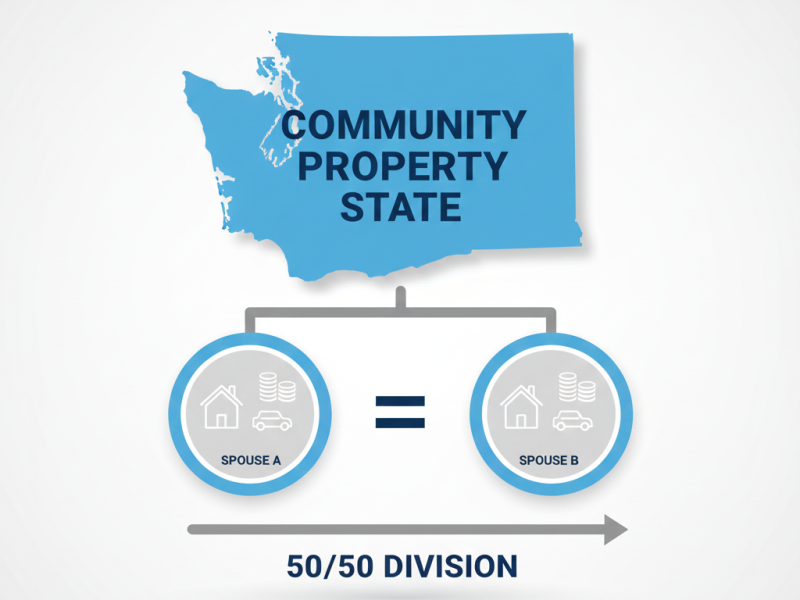
Here’s where Washington really differs from many other states. Washington is one of only nine community property states, which significantly impacts how you’ll approach spousal maintenance discussions.
In community property states, virtually everything acquired during the marriage belongs equally to both spouses, regardless of whose name is on the title or who earned the income. The general principle is that community property gets divided equally between you and your spouse.
Now, you might be thinking: “If we’re splitting everything 50-50, why would anyone need spousal maintenance?” This is precisely the kind of question we explore together in mediation. Here’s the reality — even after a fair property division, spouses often end up in very different financial positions. Perhaps one spouse made a career sacrifice to raise the children. Possibly, there’s a significant income disparity that will continue after the divorce. Alternatively, the marital standard of living may be unsustainable for both spouses if they live separately, even with an equal property split.
In mediation, we examine property division and maintenance individually and together. We’ll analyze your situation after dividing the community property, and then thoughtfully consider whether one spouse needs additional ongoing support and whether the other spouse can provide it. The beauty of mediation lies in its ability to coordinate both elements in a way that makes financial sense for your entire family.
How Washington Approaches Spousal Maintenance — And Why Mediation Gives You Better Options

What’s important to understand about how Washington handles spousal maintenance is that the state uses a factors-based approach rather than a rigid formula. The factors that come into play include the financial resources of each spouse after property division, the time needed for a spouse to gain education or training to become self-supporting, the standard of living during the marriage, the duration of the marriage, the age and health of both spouses, and each person’s ability to meet their needs while also paying support.
Because Washington doesn’t use a strict calculator or formula, you and your spouse have tremendous freedom to negotiate a maintenance arrangement that actually works for your family. Instead of having a judge who doesn’t know you make decisions about your financial future based on limited courtroom testimony, you get to design a solution together that reflects your real priorities, concerns, and circumstances.
This flexibility is precisely why mediation produces such better outcomes than litigation. You’re not fighting over what might happen in court — you’re collaborating to create what actually makes sense for both of you.
Temporary vs. Long-Term Maintenance: Planning for Both Phases
One aspect of Washington maintenance that often surprises people is that you’ll want to think about two separate phases as you negotiate your divorce agreement. During your divorce process, before everything is finalized, one spouse might need temporary maintenance to help meet living expenses while you’re working through all the details of your separation.
Temporary maintenance is meant to provide stability during the transition. It helps maintain financial equilibrium while you gather information, analyze your options, and negotiate your long-term agreement.
Long-term maintenance is what you’ll include in your final divorce agreement, and this is where the real financial planning comes in. In mediation, we take the time to thoroughly analyze post-divorce budgets for both spouses, realistic earning capacity, the time frame needed for a lower-earning spouse to build or rebuild career skills, tax implications of different maintenance structures, and how to design payments that are sustainable for the paying spouse and adequate for the receiving spouse.
The advantage of addressing both phases in mediation is that you can see how they fit together within your overall transition plan. You’re not just reacting to an immediate crisis—you’re designing a thoughtful financial roadmap.
Why Mediation Is Your Best Path for Negotiating Maintenance

Here’s something important you should know from the start: while Washington provides a framework for spousal maintenance, you don’t have to leave these critical decisions up to a judge who doesn’t know you, your marriage, or your family’s unique needs. In my nearly 20 years of helping couples navigate divorce, I’ve consistently seen that couples who choose mediation for maintenance discussions achieve better outcomes, less conflict, and agreements they actually stick to.
I need to be clear about my role: I’m not an attorney, so I can’t give you legal advice about what might happen in your specific case. What I can do is guide you through the financial analysis and negotiation process, helping you understand the key factors and design solutions tailored to your family’s unique situation.
Think about it this way. Going to court means you’re asking a stranger to decide your financial future based on a few hours of testimony. That judge doesn’t know that you put your career on hold to support your spouse’s education, or that your spouse has health issues that aren’t obvious on paper. All of those nuances get lost in litigation.
In mediation, nothing gets lost. We have the time and space to explore what’s truly important to both of you, understand your actual financial needs and capabilities, and design solutions that account for the full picture of your lives.
And here’s the real advantage: when you negotiate spousal maintenance in mediation, you’re not constrained by rigid formulas or what might happen in litigation. You can get creative in ways that the court system can’t accommodate. Consider structuring a step-down arrangement where maintenance decreases over time as the receiving spouse rebuilds their career. You could trade higher maintenance for a shorter duration, or you could adjust the amount based on specific milestones, such as completing a degree. You might exchange property for reduced or eliminated maintenance obligations.
These kinds of tailored, flexible solutions are nearly impossible to achieve through litigation. But in mediation, they’re precisely what we help couples create.
With my background in finance and extensive training in negotiation from Harvard, MIT, and Northwestern, I help couples analyze their financial situation from multiple angles. We look at cash flow, tax implications, retirement planning, and long-term economic sustainability for both households. We can run different scenarios to see how various maintenance arrangements would impact both spouses over five years, ten years, and into retirement. This kind of comprehensive financial analysis helps you make informed decisions rather than emotional ones.
When you’re dealing with the financial complexities of spousal maintenance in a community property state, having someone with deep financial expertise guiding the conversation makes an enormous difference. We don’t just look at the immediate impact of different maintenance structures — we help you anticipate how changing circumstances might affect things down the road and build appropriate flexibility into your agreement.
And importantly, agreements that you reached together tend to stick. When you’ve both participated in creating the solution, when you understand the reasoning behind it, and when it reflects your actual values and priorities, you’re far more likely to honor it.
Moving Forward with Clarity and Control
Recognizing that Washington employs its own terminology and approach to spousal maintenance is the first step toward making informed decisions about your divorce. The community property framework, the flexible factors-based approach, and the two-phase nature of support all create opportunities for thoughtful, creative negotiation when you choose mediation.
As you move forward, remember that spousal maintenance is just one piece of your overall divorce settlement, but it’s a piece that will impact your financial stability for years to come. How you approach this conversation matters enormously. You can either hand over control to the court system or take charge of your own future through mediation.
Working with an experienced mediator who understands both how Washington approaches these issues and the financial implications can make all the difference in reaching an outcome that feels fair and sets you up for a stable financial future. More than that, choosing mediation helps you end your marriage with dignity and move forward into your new life with less conflict, less expense, and more hope for what comes next.

FAQs About Spousal Maintenance in Washington State
About the Authors – Divorce Mediators You Can Trust
Equitable Mediation Services is a trusted and nationally recognized provider of divorce mediation, serving couples exclusively in California, New Jersey, Washington, New York, Illinois, and Pennsylvania. Founded in 2008, this husband-and-wife team has successfully guided more than 1,000 couples through the complex divorce process, helping them reach amicable, fair, and thorough agreements that balance each of their interests and prioritizes their children’s well-being. All without involving attorneys if they so choose.
At the heart of Equitable Mediation are Joe Dillon, MBA, and Cheryl Dillon, CPC—two compassionate, experienced professionals committed to helping couples resolve divorce’s financial, emotional, and practical issues peacefully and with dignity.

Joe Dillon, MBA – Divorce Mediator & Negotiation Expert
As a seasoned Divorce Mediator with an MBA in Finance, Joe Dillon specializes in helping clients navigate complex parental and financial issues, including:
- Physical and legal custody
- Spousal support (alimony) and child support
- Equitable distribution and community property division
- Business ownership
- Retirement accounts, stock options, and RSUs
Joe’s unique blend of financial acumen, mediation expertise, and personal insight enables him to skillfully guide couples through complex divorce negotiations, reaching fair agreements that safeguard the family’s emotional and financial well-being.
He brings clarity and structure to even the most challenging negotiations, ensuring both parties feel heard, supported, and in control of their outcome. This approach has earned him a reputation as one of the most trusted names in alternative dispute resolution.

Cheryl Dillon, CPC – Certified Divorce Coach & Life Transitions Expert
Cheryl Dillon is a Certified Professional Coach (CPC) and the Divorce Coach at Equitable Mediation. She earned a bachelor’s degree in psychology and completed formal training at The Institute for Professional Excellence in Coaching (iPEC) – an internationally recognized leader in the field of coaching education.
Her unique blend of emotional intelligence, coaching expertise, and personal insight enables her to guide individuals through divorce’s emotional complexities compassionately.
Cheryl’s approach fosters improved communication, reduced conflict, and better decision-making, equipping clients to manage divorce’s challenges effectively. Because emotions have a profound impact on shaping the divorce process, its outcomes, and future well-being of all involved.
What We Offer: Flat-Fee, Full-Service Divorce Mediation
Equitable Mediation provides:
- Full-service divorce mediation with real financial expertise
- Convenient, online sessions via Zoom
- Unlimited sessions for one customized flat fee (no hourly billing surprises)
- Child custody and parenting plan negotiation
- Spousal support and asset division mediation
- Divorce coaching and emotional support
- Free and paid educational courses on the divorce process
Whether clients are facing financial complexities, looking to safeguard their children’s futures, or trying to protect everything they’ve worked hard to build, Equitable Mediation has the expertise to guide them towards the outcomes that matter most to them and their families.
Why Couples Choose Equitable Mediation
- 98% case resolution rate
- Trusted by over 1,000 families since 2008
- Subject-matter experts in the states in which they practice
- Known for confidential, respectful, and cost-effective processes
- Recommendations by therapists, financial planners, and former clients
Equitable Mediation Services operates in:
- California: San Francisco, San Diego, Los Angeles
- New Jersey: Bridgewater, Morristown, Short Hills
- Washington: Seattle, Bellevue, Kirkland
- New York: NYC, Long Island
- Illinois: Chicago, North Shore
- Pennsylvania: Philadelphia, Bucks County, Montgomery County, Pittsburgh, Allegheny County
Schedule a Free Info Call to learn if you’re a good candidate for divorce mediation with Joe and Cheryl.