The Ultimate
Illinois Divorce Planning Guide (with Checklist)
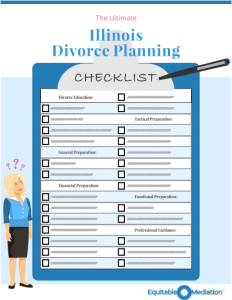
Get Your Free 51-Page Guide
We understand that considering divorce is one of life’s most challenging crossroads. While the path ahead may feel overwhelming, having a clear plan can help you feel more grounded and prepared.
That’s why we created this guide – so you don’t have to figure out these first steps alone.
Fill out the short form on this page to receive our divorce planner and checklist directly to your email inbox.
The download link will be emailed to you immediately after form submission.
Form will not submit in Firefox. Must use Chrome, Brave, or Safari.
Guide to Chicago Divorce Mediation Services
Mediation’s goal is to help you, and your spouse find mutually beneficial (“win-win”) solutions. Unlike traditional court proceedings, which are often “win-lose.” Mediation allows couples to discuss both required legal matters, as well as issues outside the scope of typical divorce litigation. These may be things like future co-parenting arrangements as children get older, introducing children to new romantic partners, or creative financial solutions such as delaying the sale of a home. This comprehensive approach enables both parties to make informed decisions about their future while maintaining control over the outcome.
Perhaps most significantly, mediation is also the most cost-effective path forward for divorcing couples. Traditional litigation can be extremely expensive and time-consuming, costing in excess of $100,000, while mediation helps parties reach an agreement in a fraction of the time, and for a fraction of the cost. This efficiency not only saves money but also reduces the emotional strain on all involved parties, allowing them to move forward with their lives more quickly and positively.
On the other hand, if you choose to litigate using a divorce attorney, you’d likely be sent to court-ordered, family law mediation. Many counties in Illinois, including Cook county, have court ordered mediation proceedings whereby a couple litigating will be required to engage in custody and parenting time mediation and an economic (financial) mediation session offered through the family courts.
And while we’re always pleased when couples mediate, no matter what route they took to get there, we feel there are a number of shortcomings with court-ordered mediation:
- First, you don’t get to choose your professional like you would with private mediation. So you could end up with someone you don’t like, or you’re not comfortable working with.
- Second, the approved individuals on the court roster may not be the most experienced. The only requirement to get on the Illinois court-ordered mediator roster is to take a 40-hour training class. So many new mediators get their start in the courts and have little or no “real-world” experience.
- Finally, what if your issues are so complex that even if the court certified mediator isn’t fresh out of training, they still aren’t experienced handling unique issues like yours? While it may be possible to reach agreements through the court’s mediation program, we strongly feel private mediation produces a far better outcome.
For couples without minor children, there are two issues which need to be negotiated and agreed upon: maintenance and property division. Whereas for cases involving minor children, issues including co-parenting responsibilities and child support, will also need to be discussed and agreed upon.
There are significant differences between mediation and using lawyers ranging from the number of professionals involved, approach, cost, speed, control, tone, and more. Highly qualified mediators like us can help you and your family reach highly-customized and lasting agreements, in a less stressful and non contentious manner. So you can remain civil, and if you have children, be the great co-parents they’re counting on you to be.
Read: Mediation vs Divorce Lawyer, to compare these options and learn the many benefits we believe mediation provides.
Since no two mediators are alike, the actual mediation process will vary from professional-to-professional. But here’s a high-level overview of what happens throughout the process once you become our client:
To kick things off, your first mediation session will be a one-hour strategy session. In this session, Joe will help you both prepare for mediation by:
- Developing a framework for your negotiations;
- Identifying key areas of concern you each have;
- Defining your goals for the process;
- Directing you to begin gathering important financial documents;
- And instructing you on how to work together to complete our proprietary forms and worksheets.
This part of the process is intended to help you, and Joe to define what a successful mediation will look like and greatly increase the chances you will come to an agreement.
Once you’ve submitted requested pre-work and discovery items to us, the mediation process transitions to negotiations.
Joe will meet with you and your spouse virtually – and guide you through a series of conversations encompassing the issues that need to be settled in your divorce. Each session lasts approximately 2-hours, and the number and frequency of sessions are determined by the details of your divorce, and the complexity of the issues you face.
If areas of disagreement arise in a mediation session, Joe will use his expertise in a variety of dispute resolution techniques to help you negotiate and overcome any impasses encountered along the way.
Once agreement is reached for all required issues, Joe will then draft a complex written document called a Memorandum of Understanding (MOU), outlining all decisions made during your negotiations. You will be encouraged to have your written agreement reviewed by your own respective lawyer; however it is your decision whether or not to do so.
Once you both agree the MOU looks good, you will then hire a filing professional who will assist with the paperwork preparation process. Your divorce papers may include, but are not limited to, the uncontested divorce filing, the divorce complaint, the marital settlement agreement, and budgets, along with a host of other related Illinois court paperwork. It’s important to note there are attorney and non-attorney filing professionals and it is your choice of which professional you use to have your divorce filed with the court. Upon receipt of the proper documentation and filing fees, your uncontested judgement of divorce will be granted by a judge as there is no waiting period in Illinois.
Our mediation process is very efficient and can be completed in a fraction of the time that a litigated divorce or collaborative law process would take.
Learn more about how you benefit by mediating with us.
Making decisions about your future during divorce can feel overwhelming, especially when the path ahead seems uncertain. We understand this challenge, which is why we’ve developed our proprietary Change of Circumstance Scenario Planning technique to help you create agreements that stand the test of time. Through our carefully designed process, we guide you through exercises that address not only your present situation but also your short, medium, and long-term future. Together, we craft comprehensive agreements that account for each of these time periods, ensuring all necessary issues are thoroughly addressed.
What sets our approach apart is our forward-thinking framework that allows for future adjustments to be performed by you and your spouse. Our agreements include highly-detailed language that allows for appropriate modifications when needed, helping families avoid costly litigation down the road. This innovative approach is just one example of how we help our clients leave mediation with thorough, comprehensive agreements that provide both immediate clarity and long-term flexibility.
The total cost of mediation varies greatly and is dependent on a number of factors including, but not limited to:
- The experience and expertise of the mediator;
- The thoroughness of their process (if they even have one);
- The comprehensiveness of the services they;
- The relationship dynamic between the parties and willingness to compromise and negotiate the issues.
You can work with an inexperienced mediator for a lower hourly rate or flat-fee, but then once mediation is completed, spend another few thousand dollars to have your agreement re-written by attorneys (and/or tens of thousands of dollars in the future to address missed issues.) Or you can work with an experienced mediator whose fee might be higher, but who delivers a more thorough service, written agreement, and resolution on both present and known/potential future issues, which will save you money, time and stress in the long run. Mediation is not “cheap divorce” but it is cost-effective with the average cost of a mediated divorce in Chicago ranging from $6,000 to $10,000.
To learn more, read: The Real Truth Behind Divorce Mediation Costs
Divorce mediation is usually a practical option for your divorce if:
- There’s a level of mutual respect between you and your spouse, and you’re both willing to actively participate;
- You’re both prepared to engage in a “good faith,” honest negotiation requiring full disclosure;
- You’re willing to respect each other’s specific needs and interests, and recognize compromise is a key component of any agreements reached;
- You want a competent divorce expert to help facilitate negotiations between you and your spouse and to provide options for you to both consider, but you both want to make your own decisions and retain full control over your divorce agreement. If one of you wishes to mediate, and one does not, unfortunately mediation will not be an option for you.
Yes. We believe strongly that in order to remain skillful in our field, we must remain dedicated exclusively to mediating family matters of divorce and separation. We do not mediate commercial, civil, elder, or community matters like others (who also mediate divorces) do. Matrimonial issues are complex and in our opinion, require a mediator to be singularly focused.
Unlike an attorney, a mediator cannot give legal advice or tell you what to do. Parties who choose to work with a mediator wish to make their own decisions on issues such as custody or property division, instead of being told what to do by an attorney.
Think of mediators like conductors in an orchestra. Conductors lead the symphony, and mediators lead the mediation process. But conductors don’t make the music, just like mediators don’t make the decisions for the parties. Yet without a conductor, or a mediator, the divorce proceedings would get off track, and the participants wouldn’t know what to do.
Learn more about divorce mediation.
Divorce mediation is a subset and is focused on helping married couples peacefully and cost-effectively end their marriage. Whereas divorce and family mediation is broader in scope, with mediators helping parties also resolve matters related to family, but not directly related to divorce. For example, creating a visitation / child custody arrangement for a child of a Chicago couple who is unmarried, or assisting with the property division of a family-owned business.
The term “alternative dispute resolution” or ADR for short, refers to any dispute resolution process that eliminates the parties need to hash out their issues and matters in court. Mediation is simply one type of ADR processes. Other common types may include, but are not limited to, collaborative divorce, arbitration, peace circles, and restorative justice. The idea behind ADR is to keep the parties out of expensive and damaging litigation, and instead, with the help of a neutral third party, for parties to reach agreement without having to go to court.
While most people think of divorce and dissolution of marriage as the same thing, in some states they are not.
Some practitioners think of a divorce as being contested, and dissolution of marriage as being uncontested. That is, in a dissolution of marriage, the issues were all handled privately, and many of the steps in a traditional divorce process were skipped (such as hiring an attorney or going to court).
In Illinois, it is common for people to use the terms divorce and dissolution of marriage interchangeably, but as non-attorney mediators, we can’t fully comment on the accuracy of this statement, nor its legal impact on a divorce case.
In Illinois, an uncontested divorce, also commonly known as a no-fault divorce, is one in which the parties are able to resolve, and come to agreement on, all of their issues, without the need to hire an attorney / attorneys and needing to have the matters decided in court.
When parties can work with a private mediator, all divorces in theory are uncontested divorces. Because a highly skilled Illinois divorce mediator will be able to help a divorcing couple resolve, and come to agreement on, all issues privately. In turn, eliminating the need for either party to hire an attorney and go to court.
One thing that’s important to note, and admittedly it’s a bit of a technicality, is that an “uncontested divorce” isn’t really a “no-fault divorce.” Every divorce has a fault; it’s just that in the case of a divorce process that uses a neutral third-party to come to agreement, the “fault” is commonly referred to “irreconcilable differences.”
© 2025 Equitable Mediation Services | Privacy Policy | Disclaimer