Dividing Retirement Accounts in Divorce:
What You Need to Know

Why retirement assets feel so overwhelming in divorce
When couples work with me, retirement accounts are often the issue that causes the most anxiety. You’ve spent twenty or thirty years watching those balances grow, and now you’re facing the reality that everything needs to be divided. It feels like your financial security is being cut in half just when you’re old enough, actually, to need it.
Here’s what I tell people after nearly two decades of helping couples navigate these decisions: dividing retirement assets doesn’t have to destroy your financial future. But it does require understanding what you’re actually dividing, because not all retirement accounts work the same way. The 401(k) you’ve been contributing to for fifteen years operates completely differently from your spouse’s pension or the IRA you rolled over from a previous job.
The couples who handle retirement division well are the ones who take time to understand what they’re working with before they start negotiating. The ones who struggle are usually operating on assumptions that turn out to be wrong.
Understanding 401(k)s, 403(b)s, and 457 plans
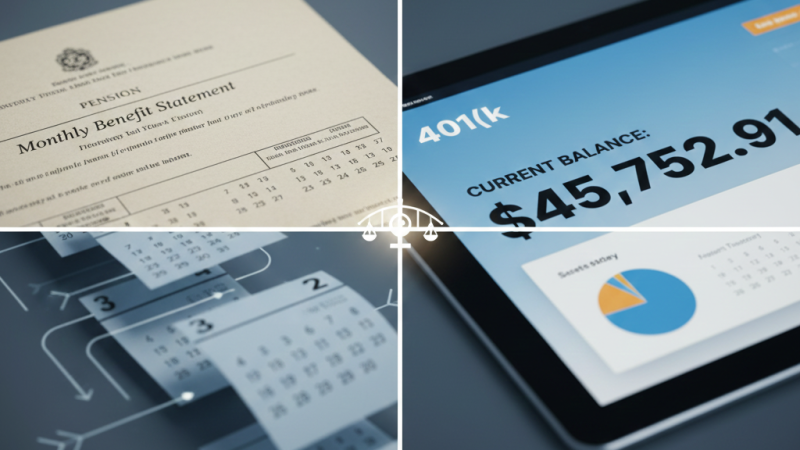
If you work in the private sector, you probably have a 401(k). Nonprofit employees typically have 403(b)s, while government workers might have 457 plans. These accounts display your current balance and grow based on your contributions and investment returns.
The key point to understand is that you can’t simply split them with a handshake. They require a special court order called a QDRO (Qualified Domestic Relations Order) that directs the plan administrator to divide the account. Without that QDRO, the money doesn’t move, no matter what your divorce decree says. I’ve watched couples finalize their divorce only to discover months later that the 401(k) was never divided because nobody dealt with the QDRO.
The QDRO process is time-consuming and must be executed correctly. Once approved, the spouse receiving a share must decide whether to withdraw the funds immediately or roll them into their own retirement account. There’s also complexity around outstanding loans, vesting schedules, and multiple accounts from different employers. Understanding how to divide 401(k)s, 403(b)s, and 457 plans properly can save you from expensive mistakes down the road.

Pensions are the most complicated retirement asset
If either of you has a traditional pension, you’re dealing with the most complex retirement asset in divorce. Unlike a 401(k), where you can see today’s balance, a pension is a promise of future monthly payments that might not start for years or even decades.
Valuing something you can’t see or touch is inherently tricky. How much is a promise of $3,500 per month starting ten years from now actually worth today? The answer depends on assumptions about life expectancy and future interest rates that reasonable people can disagree about.
You also face a fundamental choice: do you calculate the present value and offset it with other assets now, or do you wait and divide the actual pension payments when they start in the future? Survivor benefits, cost-of-living adjustments, special rules for government pensions, and questions about early retirement all factor into these decisions. For anyone dealing with a pension in divorce, understanding how pensions are valued and divided is essential to protecting your financial future.
IRAs are simpler but still require careful handling
The good news about IRAs is that they don’t require QDROs. The division process is more straightforward through a “transfer incident to divorce” – a direct transfer from one spouse’s IRA to the other’s that’s tax-free when done correctly.
But here’s where couples get into trouble. Traditional IRAs and Roth IRAs might both be called IRAs, but they’re fundamentally different from a tax perspective. A traditional IRA contains pre-tax money that gets taxed when you withdraw it. A Roth IRA contains post-tax money that comes out completely tax-free. That means a dollar in a traditional IRA is not worth the same as a dollar in a Roth IRA.
I’ve watched couples assume that because they each have $100,000 in IRAs, they’re even. But if one has a traditional and the other has a Roth, they’re not even close to even after accounting for taxes. Understanding how to divide IRAs properly, including the critical tax differences between account types, can save you from leaving significant money on the table.
Why mediation works better for retirement account division
In litigation, you’re handing your retirement security to someone who doesn’t know your financial situation and applying rigid formulas that might not serve either of you well. Everything gets split 50/50 according to some standard calculation, regardless of whether that makes sense for your circumstances.
In mediation, we can be strategic and creative. Perhaps one of you could use the money now and benefit from taking a distribution from the 401(k) with the QDRO exception to early withdrawal penalties. You might consider trading retirement assets for equity in the house. Perhaps the pension should be carefully offset against other assets. Maybe you’d prefer to determine who receives which type of IRA based on your individual tax situations.
Here’s an example from a California couple we worked with: The wife had a $300,000 traditional IRA and a $150,000 Roth IRA. The husband had a $450,000 401(k). Rather than splitting each account 50/50, we structured an agreement in which she kept her entire Roth IRA and $200,000 of her traditional IRA, while he kept his entire 401(k) and received $100,000 from her traditional IRA. Each ended up with $450,000 in retirement assets, but they avoided the complexity and cost of multiple QDROs and got the account types that made the most sense for their situations.
That kind of creative solution only happens when you’re working cooperatively in mediation. In litigation, you get formulas applied to each account individually, whether that makes sense or not.
Navigating financial complexity in retirement division
This is where having specialized financial expertise makes an enormous difference. If your compensation includes bonuses, stock options, RSUs, or equity shares flowing into your 401(k), the division becomes significantly more complex. When do you value those assets? How do you account for vesting schedules on equity compensation? What happens to unvested shares that vest after divorce but before the QDRO executes?
With an MBA in Finance and specialized training from the Institute for Divorce Financial Analysis, I can cut through this complexity. We can model different scenarios together: What if you take a larger share of the 401(k) and your spouse takes more home equity? How does that affect your long-term retirement security? Suppose one of you has a New Jersey state pension with specific COLA provisions and the other has a private sector 401(k). How do we account for those differences when creating an equitable division?
These aren’t theoretical questions – they directly impact your financial security for decades. Getting the answers right requires someone who understands both the technical aspects of retirement accounts and how to structure settlements that serve your long-term interests. You’re not just dividing numbers – you’re making decisions that will determine your quality of life throughout retirement.
Active guidance through every decision
We don’t require you to have everything figured out before coming to mediation. That’s not realistic, and that’s not how we work. Instead, we actively guide you through each decision point, presenting options and helping you understand the implications of each choice.
Should you take the QDRO distribution now or roll it over? That depends on your immediate financial needs, your tax situation, your retirement timeline, and whether you have the discipline to preserve the money rolled into an IRA. We’ll work through all these factors together.
How should you handle that 401(k) loan that’s still outstanding? We’ll look at who’s better positioned to pay it off and structure the division accordingly. What if your spouse’s pension includes unusual elements like early retirement subsidies or special service calculations? What if the plan administrator rejects the first QDRO draft because it doesn’t comply with their specific rules? You’re not navigating these complications alone or hoping you didn’t miss something critical.
Planning beyond the immediate divorce
Dividing retirement accounts isn’t just about splitting what exists today – it’s about ensuring you’re both positioned for financial security twenty or thirty years from now. That requires thinking ahead about how changes in circumstances might affect your retirement planning.
What if one spouse changes careers and stops contributing to their 401(k)? What if health issues force early retirement? What if the stock market crashes just before you planned to retire? What if one of you remarries and combines households, significantly changing your financial picture? While we can’t predict everything, we can build agreements that give you flexibility to adapt as life changes.
This future-focused approach sets mediation apart. In litigation, you get an order that divides assets based on today’s information, period. In mediation, we help you create a financial foundation that gives you confidence moving forward, regardless of what comes next.
A personalized approach to your retirement security
Every couple’s retirement situation is unique, and so are the issues you face. That’s why we don’t believe in a one-size-fits-all process. Instead, we develop a personalized approach to address your specific circumstances.
Maybe you have simple retirement accounts but complex income structures. Perhaps you have a straightforward 401(k), but your spouse has a complicated government pension. You might be dealing with multiple retirement accounts from multiple employers, or facing questions about how to divide retirement assets when there’s a significant age difference between you.
Whatever your situation, we tailor our approach to your needs. We’re not applying cookie-cutter formulas – we’re helping you solve the specific challenges you face in ways that protect both of your futures.
The choice between cooperation and conflict

Your retirement accounts represent years of disciplined saving and sacrifice. How you divide them in divorce will significantly impact your financial security for the rest of your life.
In litigation, you lose control of that decision. Someone who doesn’t know your financial life applies rigid rules and hands down orders. The process is expensive, drawn-out, and often leaves both spouses feeling frustrated with the outcome. You’re fighting over assets instead of protecting them.
In mediation, you maintain control. You make informed decisions with expert financial guidance, structure arrangements that actually work for your situation, and preserve the resources you’ve worked so hard to build. You’re working cooperatively to secure both of your futures rather than battling over formulas that might not serve either of you well.
The technical aspects of dividing 401(k)s, pensions, and IRAs are genuinely complex, but they’re manageable with proper guidance and a cooperative approach. The couples who do this well gather information early, understand what they’re working with, and approach it as a problem to solve together rather than a battle to win.
Your retirement security is too important to leave to chance, to rigid court formulas that don’t account for your real life, or to a process that depletes the very resources you’re trying to protect through legal fees and conflict. Choose the path that gives you control, expertise, and confidence about your financial future.
“When you think about divorce, legal issues might come to mind first. However, three of the four main issues that need to be resolved during divorce are actually financial in nature (with parenting being the fourth).
This is why having a mediator with strong financial expertise can be particularly valuable in reaching a well-informed, sustainable agreement.”

Joe Dillon, MBA
| Divorce Mediator & Founder
FAQs About Dividing Retirement Accounts in Divorce
The Mediation Advantage for Maintenance Discussions
Throughout these FAQs, you’ve seen references to mediation as an alternative to litigation. In litigation, attorneys fight over what guidelines produce and argue about how factors apply. You’re spending tens of thousands on adversarial processes that often produce outcomes neither party accepts. For co-parents, this poisons the relationship foundation you need for years ahead.
In mediation, you’re working together to understand what the guidelines say, whether they fit your circumstances, and what alternatives might work better. When you combine that collaborative process with genuine financial expertise—the ability to model scenarios, calculate present values, analyze tax impacts, and structure creative solutions—you get agreements that are both fair and sustainable.
That’s what makes the difference between maintenance arrangements that work and ones that create ongoing conflict.