Suppose you and your spouse have a combined income exceeding $183,000. In that case, you’re facing one of the most unpredictable aspects of New York divorce: how child support gets calculated above the statutory cap. For high-income families, this uncertainty can be financially significant. Understanding how this works—and choosing mediation over litigation—gives you control over an otherwise uncertain outcome.
Understanding the Cap Structure

New York applies a straightforward formula to combined parental income up to $183,000: 17% for one child, 25% for two, 29% for three, 31% for four, and at least 35% for five or more. This formula is mandatory and predictable.
Once your combined income crosses that threshold, predictability ends. New York doesn’t require the same formula for excess income. Instead, multiple approaches are possible, and the outcome depends heavily on how you navigate the process.
Three Approaches Above the Cap
Apply the Standard Percentage to All Excess—Continue using the same percentage. With two children and a combined income of $300,000, that means 25% of the $117,000 above the cap. Straightforward but may exceed actual needs.
Apply the Percentage to Some Excess—Set an effective cap between $183,000 and actual income. Using $250,000 as the effective cap, even when the actual income is $300,000. This middle-ground approach is common.
Use Specific Factors Instead of Formula—Abandon the formula for excess income and focus on factors New York identifies as relevant. This is where mediation becomes most valuable.
Ten Factors That Matter Above the Cap
New York identifies ten factors for evaluating child support above the cap, and understanding these shows where negotiation leverage exists.
Financial resources of both parents and children, including assets and trust funds, matter beyond just income. Physical and emotional health considerations become essential, especially for individuals with special needs who require ongoing medical care or specialized services. The standard of living your children enjoyed matters—if your family traveled internationally or provided specific educational opportunities, those patterns count.
Tax consequences affect everyone’s actual financial position. With my MBA, I help couples understand after-tax implications so decisions make sense. Non-monetary contributions both parents make toward care are considered. Educational needs—private school, special education, or college planning—should be factored in.
Substantial income differences matter, as do the needs of other children either parent supports (though only if those children have fewer resources available). Extraordinary visitation expenses can be factored in when they substantially reduce the other parent’s costs. Any other relevant factors ensure that unique circumstances are considered.
Why Litigation is Unpredictable for High-Income Cases
There’s no single “right” answer above the cap. Judges have enormous discretion—one might apply the formula to $500,000 of income while another caps it at $250,000 with identical facts.
This creates three problems. First, genuine unpredictability makes settlement negotiations harder. Second, high-income litigation gets expensive—easily $50,000 or more in fees. Third and most important, litigation removes your control. A stranger who doesn’t know your family makes the final decision about your finances.
How Mediation Changes the Equation

In mediation, you control the outcome. Instead of a judge deciding, you and your spouse negotiate an agreement that works for your family.
The flexibility above the cap becomes an advantage. You can apply percentages to a chosen income level, put funds into educational trusts instead of monthly payments, or agree on amounts reflecting actual expenses. With financial expertise in the room, we model scenarios, understand tax implications, and ensure numbers work for both of you. My training from Harvard, MIT, and Northwestern means I can help you understand the real economic impact of different approaches.
A Real-World Example
Consider a couple with two children and a combined income of $350,000—$200,000 from one parent and $150,000 from the other. The first $183,000 calculation is straightforward: 25% equals $45,750 annually, divided proportionally.
But the remaining $167,000? Simply applying 25% adds $41,750, bringing total support to over $87,000 annually. That might be appropriate for some families with significant expenses or special needs. For others, it exceeds actual needs.
In mediation, this couple examines real expenses. Private school costs $40,000 annually. Extracurricular activities and summer programs cost $15,000. Healthcare and therapy for a child with learning differences costs $8,000. When you add housing, food, clothing, and basics, the real number becomes clear—and they can agree on an approach reflecting that reality rather than leaving it to a judge.
Protecting Children’s Lifestyle While Being Fair
Your children shouldn’t suffer financially because you’re divorcing if they’ve grown up with certain advantages—quality education, travel, enrichment opportunities—maintaining those matters. At the same time, support should reflect actual needs rather than simply applying percentages to large numbers.
In mediation, we have honest conversations about what your children truly need. What does maintaining their standard of living actually require? These discussions benefit from financial expertise—understanding after-tax impact, modeling different scenarios, and finding solutions that work for both parents.
Educational Expenses Deserve Special Attention
Above-cap income becomes particularly relevant for educational expenses. New York allows educational expense awards beyond basic support, but they aren’t automatic—they depend on factors like parental educational background and family history.
In mediation, you address this directly. Apply the standard formula to a specific income level for basic support, then separately address educational expenses through specific allocation or 529 plan funding. This creative problem-solving is difficult in litigation but natural in mediation.
Looking at the Complete Picture
Child support doesn’t exist in isolation. You’re negotiating property division, possibly spousal maintenance, and other financial aspects. For high-income families, these pieces interact significantly.
Spousal maintenance affects both parents’ incomes for child support purposes. Asset division generating future income matters too. This integrated approach is a strength in mediation—instead of fighting separate battles, you see how the pieces fit together and make trade-offs that reflect your priorities.
Why Financial Expertise Matters
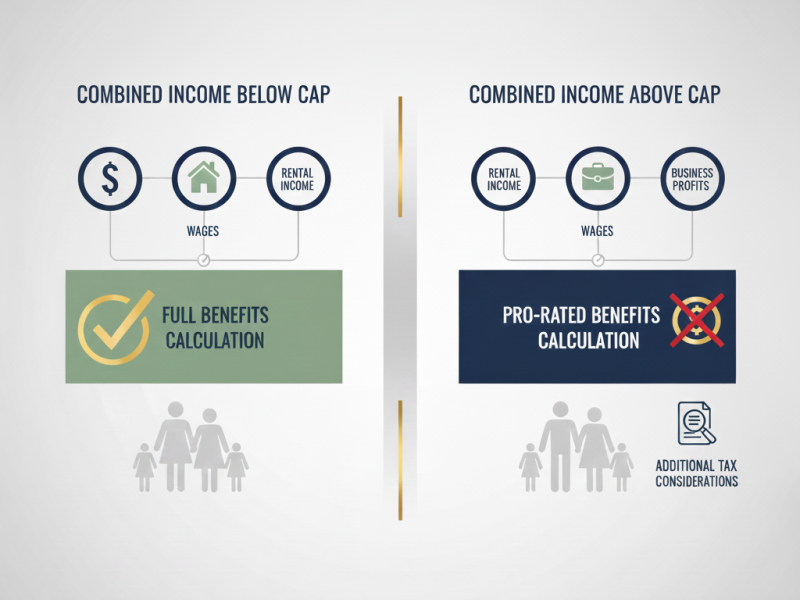
Above-cap calculations involve complex analysis. High incomes come from multiple sources—salary, bonuses, equity compensation, business income, and investments. Understanding how these work and interact with child support requires real financial acumen.
My MBA and extensive financial training have become particularly valuable here. I help you understand business income calculations, equity compensation treatment, variable bonus handling, and structures accommodating income fluctuations. High-income situations also involve tax complexity, where after-tax cash flow analysis matters significantly.
Moving Forward with Control
If your combined income exceeds $183,000, you face significant financial decisions about child support. Litigation means uncertainty, expense, and loss of control. Mediation means clarity, efficiency, and the maintenance of decision-making authority.
Work with a mediator who brings both extensive divorce mediation experience and advanced financial expertise to navigate the complexity of high-income child support. Your children deserve parents who move forward cooperatively, and you deserve a process that preserves your resources.
The flexibility in New York’s above-cap approach isn’t a problem—it’s an opportunity. An opportunity to craft arrangements truly serving your children’s needs while being fair to both parents. An opportunity to maintain control over critical financial decisions. An opportunity to resolve this collaboratively rather than contentiously. If you’re ready to navigate this thoughtfully and keep control over outcomes affecting your children’s well-being, let’s discuss how mediation can help.

FAQs About New York Child Support
About the Authors – Divorce Mediators You Can Trust
Equitable Mediation Services is a trusted and nationally recognized provider of divorce mediation, serving couples exclusively in California, New Jersey, Washington, New York, Illinois, and Pennsylvania. Founded in 2008, this husband-and-wife team has successfully guided more than 1,000 couples through the complex divorce process, helping them reach amicable, fair, and thorough agreements that balance each of their interests and prioritizes their children’s well-being. All without involving attorneys if they so choose.
At the heart of Equitable Mediation are Joe Dillon, MBA, and Cheryl Dillon, CPC—two compassionate, experienced professionals committed to helping couples resolve divorce’s financial, emotional, and practical issues peacefully and with dignity.

Joe Dillon, MBA – Divorce Mediator & Negotiation Expert
As a seasoned Divorce Mediator with an MBA in Finance, Joe Dillon specializes in helping clients navigate complex parental and financial issues, including:
- Physical and legal custody
- Spousal support (alimony) and child support
- Equitable distribution and community property division
- Business ownership
- Retirement accounts, stock options, and RSUs
Joe’s unique blend of financial acumen, mediation expertise, and personal insight enables him to skillfully guide couples through complex divorce negotiations, reaching fair agreements that safeguard the family’s emotional and financial well-being.
He brings clarity and structure to even the most challenging negotiations, ensuring both parties feel heard, supported, and in control of their outcome. This approach has earned him a reputation as one of the most trusted names in alternative dispute resolution.

Cheryl Dillon, CPC – Certified Divorce Coach & Life Transitions Expert
Cheryl Dillon is a Certified Professional Coach (CPC) and the Divorce Coach at Equitable Mediation. She earned a bachelor’s degree in psychology and completed formal training at The Institute for Professional Excellence in Coaching (iPEC) – an internationally recognized leader in the field of coaching education.
Her unique blend of emotional intelligence, coaching expertise, and personal insight enables her to guide individuals through divorce’s emotional complexities compassionately.
Cheryl’s approach fosters improved communication, reduced conflict, and better decision-making, equipping clients to manage divorce’s challenges effectively. Because emotions have a profound impact on shaping the divorce process, its outcomes, and future well-being of all involved.
What We Offer: Flat-Fee, Full-Service Divorce Mediation
Equitable Mediation provides:
- Full-service divorce mediation with real financial expertise
- Convenient, online sessions via Zoom
- Unlimited sessions for one customized flat fee (no hourly billing surprises)
- Child custody and parenting plan negotiation
- Spousal support and asset division mediation
- Divorce coaching and emotional support
- Free and paid educational courses on the divorce process
Whether clients are facing financial complexities, looking to safeguard their children’s futures, or trying to protect everything they’ve worked hard to build, Equitable Mediation has the expertise to guide them towards the outcomes that matter most to them and their families.
Why Couples Choose Equitable Mediation
- 98% case resolution rate
- Trusted by over 1,000 families since 2008
- Subject-matter experts in the states in which they practice
- Known for confidential, respectful, and cost-effective processes
- Recommendations by therapists, financial planners, and former clients
Equitable Mediation Services operates in:
- California: San Francisco, San Diego, Los Angeles
- New Jersey: Bridgewater, Morristown, Short Hills
- Washington: Seattle, Bellevue, Kirkland
- New York: NYC, Long Island
- Illinois: Chicago, North Shore
- Pennsylvania: Philadelphia, Bucks County, Montgomery County, Pittsburgh, Allegheny County
Schedule a Free Info Call to learn if you’re a good candidate for divorce mediation with Joe and Cheryl.