When you’re navigating divorce or separation, parenting time and child support often feel like two separate puzzles. You might discuss custody schedules with one part of your brain while calculating financial obligations with another.
But in New Jersey, these elements are deeply interconnected. Your parenting schedule directly impacts your child support calculation, and financial realities can inform what schedules are practically sustainable. Recognizing this connection can help you reach better agreements.
At the same time, this interconnection creates risks. When parents understand that schedule changes affect support amounts, there’s a temptation to let financial considerations drive parenting decisions in ways that don’t serve children’s best interests.
Let me help you navigate this terrain by understanding both the connections and the boundaries that should guide your decisions.
Understanding the Financial Connection

In New Jersey, your parenting arrangement directly affects child support through the overnight percentage threshold. Whether you use the sole or shared parenting worksheet depends on the overnight distribution, which significantly impacts the support amount.
Beyond worksheet selection, parenting time influences support in other ways. When you have children more often, you’re incurring more direct expenses. The calculation accounts for this by adjusting the amount transferred between households relative to the amount spent directly by each parent.
This financial reality means you can’t finalize your child support calculation until you know your parenting schedule. But it also means you need to understand the financial implications of different scheduling options as you design your arrangement.
The Right Order of Operations
Here’s the approach I recommend: design your parenting schedule primarily based on your children’s needs, your family’s circumstances, and what works practically. Then calculate child support based on that schedule. Finally, if the financial result creates genuine concerns, you can revisit the schedule, but only if adjustments still serve your children’s interests.
This sequence keeps your priorities straight. Your children need a parenting arrangement that provides stability, maintains their relationships with both parents, and works logistically with school, activities, and work schedules.
Financial considerations are legitimate and essential. But finances should inform your decisions, not control them. You’re trying to find the sweet spot where your schedule works well for your children and creates a financial arrangement both parents can manage.
Common Pitfalls to Avoid
One pitfall is “backward engineering,” where a parent determines what child support amount they want, then works backward to figure out what schedule would produce that number. The schedule becomes a means to a financial end.
Another problematic pattern is treating parenting time as a bargaining chip. Sometimes parents suggest they’ll accept less time in exchange for lower support, or push for more time specifically to reduce payments. This transactional approach treats children’s time as something to trade.
A third pitfall is fixating on schedule details that make minimal financial difference. Parents sometimes obsess over whether a schedule gives one parent 27% or 29% of overnights, losing sight of what actually matters for their children’s well-being.
The Danger of Financial Manipulation
Schedules designed primarily for financial targets rather than children’s well-being rarely work well in practice. They break down when reality intervenes, creating ongoing conflict and requiring constant renegotiation.
When a proposed schedule seems awkward or unnatural—say, with one parent having exactly 104 overnights when a more logical schedule would be 95 or 115—questions arise about whether the arrangement will actually be sustainable. Agreements built on contrived schedules often fail because they weren’t designed with real life in mind.
Beyond practicality issues, manipulated schedules damage trust between co-parents. When one parent suspects the other designed a schedule primarily for financial benefit, it poisons the cooperative relationship you’ll need for years of co-parenting decisions ahead.
How to Negotiate These Elements Productively
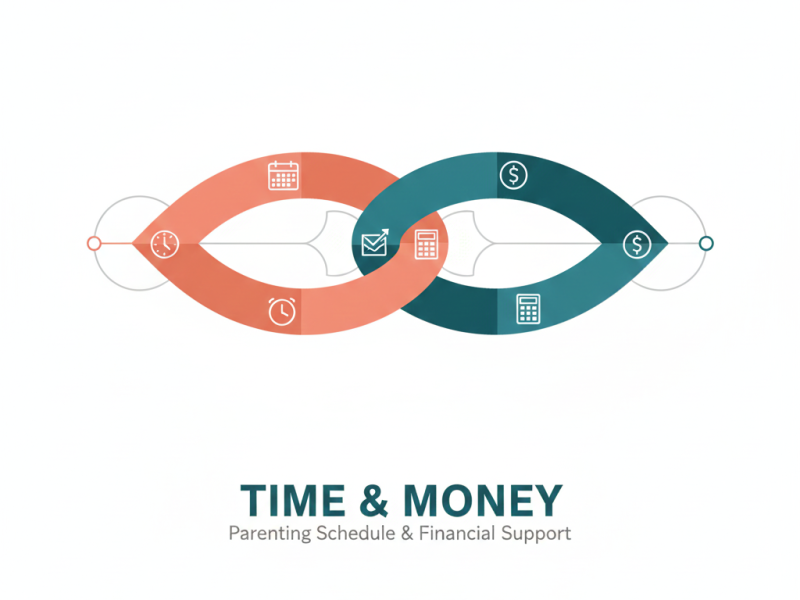
The most successful negotiations follow a thoughtful process that acknowledges the connection between parenting time and support while maintaining appropriate boundaries.
Start by discussing your children’s needs and circumstances. What schedule will provide stability? How can you both remain actively involved? What works logistically? Have this conversation focused on your children, not financial outcomes.
Once you’ve identified workable schedule options, run the child support calculation for each. This shows you the financial implications.
If one schedule creates genuine financial hardship, discuss whether modest adjustments might help without compromising what the children need. If all reasonable options create strain, address the financial issue through other means, such as expense-sharing arrangements or cost-reduction measures.
The Role of Transparency
Transparent communication about both your parenting preferences and financial situations is essential.
On the parenting side, be honest about your capacity for different arrangements. If you travel frequently for work, acknowledge that rather than committing to a schedule you can’t maintain. If you genuinely want more parenting time, express that clearly.
On the financial side, provide complete income information and be transparent about constraints. If a particular support amount would genuinely create hardship, explain your situation with specifics.
This transparency allows you both to problem-solve together. When you understand each other’s real concerns and constraints, you can look for solutions that address both parents’ needs while serving your children.
Building in Flexibility
Because parenting time and support are connected, your agreement should address how you’ll handle changes over time.
Children’s needs evolve. A schedule that works for a preschooler might not work for a teenager. Your work circumstances might change, affecting possible schedules. These life changes might affect both parenting time and appropriate support amounts.
Some parents include provisions for reviewing and adjusting both elements at specified intervals or if circumstances change significantly. Others prefer to establish clear arrangements, understanding that modifications may be needed as life evolves.
Think about what level of flexibility will work for your co-parenting relationship.
Why Mediation Is Essential for These Interconnected Decisions
Here’s what makes these negotiations so challenging: you’re trying to balance your children’s developmental needs, logistical realities, emotional concerns, financial implications, and long-term sustainability—all at once. And these decisions are deeply interconnected, making it nearly impossible to optimize one without considering the others.
Litigation handles this complexity terribly. In court, parenting time and child support often get treated as separate battles, sometimes argued at different hearings with different focuses. You might fight over a custody schedule in one proceeding without fully understanding how it affects support calculations, then later fight over the financial numbers without the flexibility to adjust the schedule if needed.
The adversarial nature of litigation creates perverse incentives that undermine child-focused decision-making. Each parent has attorneys pushing them to advocate for positions that maximize their financial position or minimize their obligations, regardless of what actually makes sense for the children. A parent might be pushed to demand a schedule they don’t really want because it affects support, or to resist one that would work better for the same reason.
Litigation also loses the nuance that makes these decisions work in real life. When you’re presenting arguments to a judge, complexity gets flattened into rigid positions. The creative solutions that might emerge from collaborative discussion—like sharing specific expenses directly, building in review mechanisms, or adjusting other aspects of the agreement to address financial concerns—get lost in the adversarial process.
You’ll pay significant fees to attorneys who argue over percentage points and formula details, often without the holistic understanding of how all these pieces fit together for your actual family. And you surrender control over the outcome to someone who doesn’t know your children, your work schedules, or what your family values.
Mediation offers something fundamentally different. You and your co-parent work with a skilled mediator to consider both parenting time and financial arrangements simultaneously, understanding how they interact and affect one another. You can design a schedule that truly works for your children, see the financial implications immediately, and make thoughtful adjustments if needed—all while maintaining focus on what serves your family.
In mediation, you can run different scenarios together. What if we structured it this way? How would that affect support? Does that feel fair? Would it actually work with our work schedules? This collaborative exploration leads to solutions that make sense on all levels because you’re considering all the factors together.
The transparency that mediation encourages also helps you avoid the trap of schedule manipulation. When you’re working together rather than against each other, you can be honest about what parenting arrangements actually make sense and what financial constraints are real versus strategic positioning.
Moving Forward with Expert Guidance

Parenting time and child support are interconnected in New Jersey’s system, and that connection is intentional and reasonable. Children need both time with their parents and financial support from both parents.
Your job in negotiating isn’t to outsmart the system or manipulate formulas. It’s to create arrangements that genuinely serve your children while being fair and sustainable for both parents.
Working with an experienced divorce mediator who understands both the family dynamics and the financial complexities makes an enormous difference. I can help you navigate these interconnected decisions by running calculations across different scenarios, helping you see the whole picture, and guiding you toward solutions that work at all levels.
We can design a parenting schedule that serves your children’s needs, understand the financial implications together, and make thoughtful adjustments if needed—always keeping your children’s wellbeing at the center. We can build in the flexibility you need for your family while creating clear enough structures to avoid future conflict.
This approach leads to agreements that work well in practice, that both parents can feel good about, and that preserve the cooperative relationship you’ll need for years of co-parenting decisions ahead. You maintain control over these crucial decisions instead of surrendering them to strangers in a courtroom, and you do so while building the foundation for effective co-parenting that will serve your children well long after your divorce is finalized.
You don’t need to navigate the complexity of these interconnected decisions alone or fragment them through an adversarial court process. With the proper guidance and a collaborative approach, you can create agreements that genuinely work for your family.

FAQs About New Jersey Child Support
About the Authors – Divorce Mediators You Can Trust
Equitable Mediation Services is a trusted and nationally recognized provider of divorce mediation, serving couples exclusively in California, New Jersey, Washington, New York, Illinois, and Pennsylvania. Founded in 2008, this husband-and-wife team has successfully guided more than 1,000 couples through the complex divorce process, helping them reach amicable, fair, and thorough agreements that balance each of their interests and prioritizes their children’s well-being. All without involving attorneys if they so choose.
At the heart of Equitable Mediation are Joe Dillon, MBA, and Cheryl Dillon, CPC—two compassionate, experienced professionals committed to helping couples resolve divorce’s financial, emotional, and practical issues peacefully and with dignity.

Joe Dillon, MBA – Divorce Mediator & Negotiation Expert
As a seasoned Divorce Mediator with an MBA in Finance, Joe Dillon specializes in helping clients navigate complex parental and financial issues, including:
- Physical and legal custody
- Spousal support (alimony) and child support
- Equitable distribution and community property division
- Business ownership
- Retirement accounts, stock options, and RSUs
Joe’s unique blend of financial acumen, mediation expertise, and personal insight enables him to skillfully guide couples through complex divorce negotiations, reaching fair agreements that safeguard the family’s emotional and financial well-being.
He brings clarity and structure to even the most challenging negotiations, ensuring both parties feel heard, supported, and in control of their outcome. This approach has earned him a reputation as one of the most trusted names in alternative dispute resolution.

Cheryl Dillon, CPC – Certified Divorce Coach & Life Transitions Expert
Cheryl Dillon is a Certified Professional Coach (CPC) and the Divorce Coach at Equitable Mediation. She earned a bachelor’s degree in psychology and completed formal training at The Institute for Professional Excellence in Coaching (iPEC) – an internationally recognized leader in the field of coaching education.
Her unique blend of emotional intelligence, coaching expertise, and personal insight enables her to guide individuals through divorce’s emotional complexities compassionately.
Cheryl’s approach fosters improved communication, reduced conflict, and better decision-making, equipping clients to manage divorce’s challenges effectively. Because emotions have a profound impact on shaping the divorce process, its outcomes, and future well-being of all involved.
What We Offer: Flat-Fee, Full-Service Divorce Mediation
Equitable Mediation provides:
- Full-service divorce mediation with real financial expertise
- Convenient, online sessions via Zoom
- Unlimited sessions for one customized flat fee (no hourly billing surprises)
- Child custody and parenting plan negotiation
- Spousal support and asset division mediation
- Divorce coaching and emotional support
- Free and paid educational courses on the divorce process
Whether clients are facing financial complexities, looking to safeguard their children’s futures, or trying to protect everything they’ve worked hard to build, Equitable Mediation has the expertise to guide them towards the outcomes that matter most to them and their families.
Why Couples Choose Equitable Mediation
- 98% case resolution rate
- Trusted by over 1,000 families since 2008
- Subject-matter experts in the states in which they practice
- Known for confidential, respectful, and cost-effective processes
- Recommendations by therapists, financial planners, and former clients
Equitable Mediation Services operates in:
- California: San Francisco, San Diego, Los Angeles
- New Jersey: Bridgewater, Morristown, Short Hills
- Washington: Seattle, Bellevue, Kirkland
- New York: NYC, Long Island
- Illinois: Chicago, North Shore
- Pennsylvania: Philadelphia, Bucks County, Montgomery County, Pittsburgh, Allegheny County
Schedule a Free Info Call to learn if you’re a good candidate for divorce mediation with Joe and Cheryl.