If you and your co-parent are higher-income earners navigating divorce or separation, you’ve probably discovered something surprising: New Jersey’s child support guidelines don’t go up forever. There’s a maximum combined income level where the economic table stops, and beyond that point, the calculation becomes less straightforward.
This realization often creates anxiety. You might wonder whether you’ll pay an excessive amount or whether your children will receive adequate support. You might have heard stories about contentious battles over lifestyle expectations.
While above-guidelines cases involve greater complexity than straightforward calculations, New Jersey has established principles for handling them. Understanding the framework can help you approach these discussions more productively.
Understanding the Guidelines Maximum

New Jersey’s Child Support Guidelines use an economic table based on research about how families at different income levels allocate resources toward child-rearing. This research provides solid data on spending patterns across a wide range of income levels. Still, the data becomes less reliable at very high income levels simply because there are fewer families in that range to study.
Currently, the New Jersey guidelines cap combined net income at a certain threshold. When your combined income exceeds this amount, you’ve moved into what’s called “above-guidelines” territory.
This doesn’t mean the guidelines are irrelevant to your situation. The guideline calculation for the maximum amount serves as a floor, a starting point for determining appropriate support. But the final amount requires additional analysis beyond simply plugging numbers into the formula.
Why the Guidelines Have a Cap
From a financial analysis perspective, the cap makes sense. Child-rearing costs don’t increase proportionally with income forever. A family earning $500,000 annually doesn’t typically spend five times as much on basic child needs as a family earning $100,000.
At higher income levels, additional income often goes toward wealth accumulation or luxury expenditures rather than child-rearing necessities. The challenge becomes distinguishing between maintaining an appropriate standard of living for children and simply extrapolating costs upward indefinitely.
The guidelines cap recognizes that beyond a certain point, the relationship between income and child-rearing costs requires individualized analysis rather than a one-size-fits-all formula.
Approaches for Above-Guidelines Calculations
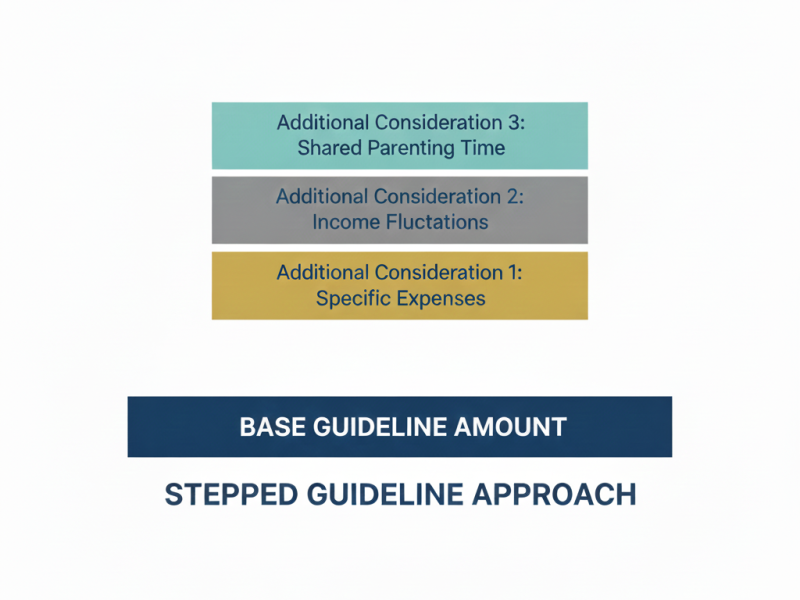
When your combined income exceeds the guidelines maximum, New Jersey recognizes several approaches for determining appropriate child support.
One standard method calculates the guideline amount at the maximum income level and adds a percentage of income above that level. This creates a mathematical extension that recognizes higher income should result in higher support, but at a decreasing rate.
Another approach involves examining the lifestyle your children enjoyed during the marriage and calculating the cost to maintain it. This requires a detailed financial analysis of historical spending patterns on child-related expenses.
The key principle is that children should not be economic victims of divorce. They should maintain a lifestyle reasonably comparable to what they would have experienced in an intact household, given the parents’ income and resources.
The Role of Discretion and Judgment
Above-guidelines cases inevitably involve more discretion than straightforward calculations. This discretion is actually an opportunity for thoughtful, individualized decision-making. In mediation, you and your co-parent can consider factors that matter specifically to your children. Maybe your family has always prioritized educational enrichment, international travel, or serious athletic pursuits requiring significant investment.
The flexibility in the above guidelines cases allows you to build a support arrangement that reflects your family’s values and priorities rather than having standardized assumptions imposed on your situation.
Financial Analysis for Higher-Income Families
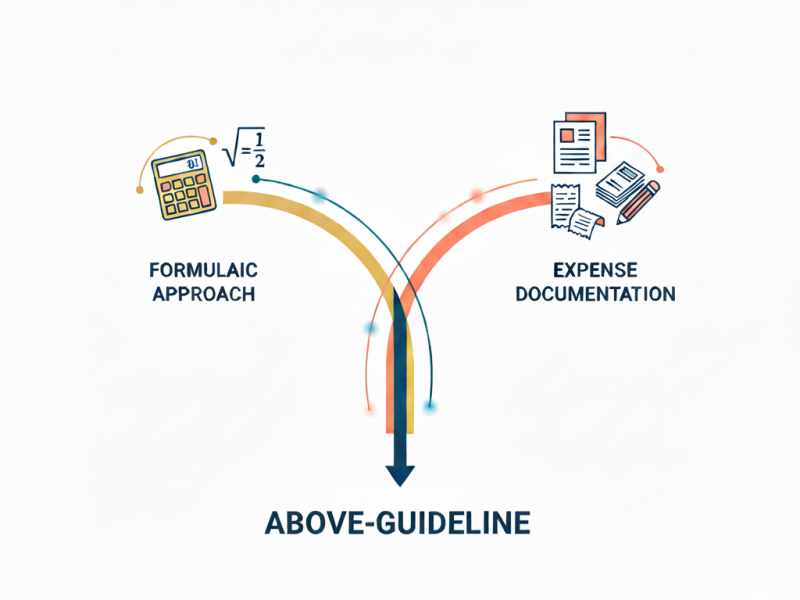
Determining appropriate support above the guidelines requires sophisticated financial analysis. This means gathering comprehensive documentation of the family’s historical spending, including credit card, bank, and receipts, to understand actual expenditure patterns. You need to identify which expenses are truly child-related and which are adult expenses.
Housing costs need an appropriate allocation. Educational expenses are usually counted in full, including tuition, enrichment activities, tutoring, and supplies. For higher-income families, educational investment often represents a significant child-rearing expenditure.
Healthcare costs beyond insurance, transportation related to children’s activities, and vacation expenses all require thoughtful consideration. The analysis distinguishes between costs directly related to children and those related to adult preferences.
Lifestyle Maintenance Considerations
One delicate issue in the above guidelines cases involves lifestyle expectations. Children who have grown up in high-income households develop certain expectations and have experienced particular standards of living.
This doesn’t mean children are entitled to unlimited luxury. But if your children have attended private school, participated in competitive sports requiring travel, or grown up with specific amenities, these factors legitimately inform what “appropriate support” means for your family.
In mediation, I help parents focus on the children’s best interests. The question isn’t whether children technically “need” various things, but what maintaining reasonable continuity in their lives looks like given the family’s established circumstances.
Documentation and Evidence
Above-guidelines cases require extensive documentation. You’ll need comprehensive financial records showing income sources, including multiple years of tax returns, particularly if income varies. Pay stubs, bonus statements, and investment income documentation all matter.
You’ll also need evidence of actual spending on child-related expenses: tuition payments, activity fees, healthcare costs, clothing expenses, and other child-related spending. The more detailed and organized your documentation, the more productive your negotiations can be.
For self-employed parents or those with complex compensation, detailed financial statements become essential for presenting a clear picture of actual available income.
Why High-Income Cases Become Nightmares in Litigation
Here’s what you need to understand: above-guidelines cases in litigation become extraordinarily expensive and contentious. When you’re in court, each parent typically hires not just attorneys, but financial experts to argue competing visions of appropriate support.
In litigation, you’ll pay tens of thousands in fees for attorneys and experts to fight over every detail of your lifestyle spending. Discovery becomes invasive as opposing counsel demands years of credit card statements, receipts, and documentation of every expenditure. They’ll scrutinize your vacations, your children’s activities, your housing choices—all in an adversarial setting designed to create winners and losers.
The process typically drags on for a year or more as experts prepare reports, attorneys file motions, and court dates get scheduled and rescheduled. You’ll sit through depositions where opposing counsel questions your spending decisions and parenting choices. The costs mount into six figures while the conflict intensifies.
Worst of all, you ultimately surrender the decision to a judge who doesn’t know your family, doesn’t understand the nuances of your children’s needs or your family’s values, and who has limited time to wade through mountains of financial documentation. That judge will impose a solution based on incomplete information presented in an adversarial context.
The litigation process itself damages the co-parenting relationship you’ll need for years to come. When you’ve spent months fighting over every aspect of lifestyle spending in a courtroom, maintaining cooperative communication about your children becomes exponentially more complicated.
Mediation: The Superior Path for High-Income Families
Mediation offers high-income families something dramatically different: the opportunity to craft solutions that actually make sense for your specific circumstances while maintaining control over the outcome.
In mediation, you and your co-parent work together with a skilled mediator to examine your historical spending patterns, discuss what maintaining your children’s lifestyle actually requires, and reach a support agreement that feels fair to both of you. You maintain the privacy of your financial details rather than have them paraded through public court proceedings.
The collaborative nature of mediation allows you to explore creative solutions that would never emerge in litigation. Maybe you agree to handle certain expenses directly rather than through support payments. Maybe you build in mechanisms to share extraordinary costs. Maybe you create flexible arrangements that adjust as your children’s needs evolve.
You save substantial sums on professional fees by working cooperatively rather than adversarially. More importantly, you preserve the relationship you’ll need to co-parent effectively through your children’s school years, college decisions, and beyond.
Negotiating Above-Guidelines Support Cooperatively
The flexibility in the above guidelines cases makes them particularly well-suited to mediation. You and your co-parent can work together to craft an arrangement that makes sense for your family.
Transparency about finances and spending patterns is essential. When both parents can see the complete financial picture and understand historical spending, you can have more grounded conversations.
It’s helpful to break down the analysis into components: housing, education, healthcare, activities, transportation, and discretionary expenses. Discussing specific spending categories makes reaching an agreement easier.
Consider building in mechanisms to address changing circumstances, such as provisions for actual educational expenses or periodic recalculations as children’s needs evolve.
Moving Forward with Expert Financial Guidance
Being in above-guidelines territory doesn’t have to mean contentious litigation or arbitrary decision-making. With proper financial analysis, comprehensive documentation, and a collaborative mindset, you and your co-parent can reach agreements that serve your children well.
But here’s the reality: this level of financial sophistication requires real expertise. Analyzing complex spending patterns, determining appropriate allocations of housing costs, evaluating lifestyle maintenance needs, understanding how parenting time affects child support calculations, and structuring agreements that work for high-income families aren’t tasks most people can navigate alone.
This is exactly where having a divorce mediator with advanced financial training becomes crucial. With an MBA in finance and extensive experience working with higher-income families, I can help you cut through the financial complexity that makes these cases challenging. We can analyze your spending patterns together, determine reasonable allocation methods, and help both parents understand the complete financial picture.
When your earnings involve sophisticated compensation structures—bonuses, stock options, RSUs, equity shares—or when you own businesses or have significant investment income, you need someone who can look at the complete financial landscape with a trained eye. I can help you understand what the numbers actually mean for your family’s future and guide you toward agreements that protect what you’ve built.
The goal should be reaching an agreement that both parents can live with, adequately supports your children, and reflects your family’s actual circumstances and values. In mediation, we can have thoughtful conversations about your priorities, explore different approaches, and craft solutions that preserve your children’s lifestyle while being fair to both parents.
You don’t need to surrender these critical decisions to strangers in a courtroom or spend six figures fighting over them. High-income divorce cases deserve the sophistication that mediation with financial expertise provides—helping you reach agreements on your own terms while preserving the cooperative relationship that will serve your family well for years to come.

FAQs About New Jersey Child Support
About the Authors – Divorce Mediators You Can Trust
Equitable Mediation Services is a trusted and nationally recognized provider of divorce mediation, serving couples exclusively in California, New Jersey, Washington, New York, Illinois, and Pennsylvania. Founded in 2008, this husband-and-wife team has successfully guided more than 1,000 couples through the complex divorce process, helping them reach amicable, fair, and thorough agreements that balance each of their interests and prioritizes their children’s well-being. All without involving attorneys if they so choose.
At the heart of Equitable Mediation are Joe Dillon, MBA, and Cheryl Dillon, CPC—two compassionate, experienced professionals committed to helping couples resolve divorce’s financial, emotional, and practical issues peacefully and with dignity.

Joe Dillon, MBA – Divorce Mediator & Negotiation Expert
As a seasoned Divorce Mediator with an MBA in Finance, Joe Dillon specializes in helping clients navigate complex parental and financial issues, including:
- Physical and legal custody
- Spousal support (alimony) and child support
- Equitable distribution and community property division
- Business ownership
- Retirement accounts, stock options, and RSUs
Joe’s unique blend of financial acumen, mediation expertise, and personal insight enables him to skillfully guide couples through complex divorce negotiations, reaching fair agreements that safeguard the family’s emotional and financial well-being.
He brings clarity and structure to even the most challenging negotiations, ensuring both parties feel heard, supported, and in control of their outcome. This approach has earned him a reputation as one of the most trusted names in alternative dispute resolution.

Cheryl Dillon, CPC – Certified Divorce Coach & Life Transitions Expert
Cheryl Dillon is a Certified Professional Coach (CPC) and the Divorce Coach at Equitable Mediation. She earned a bachelor’s degree in psychology and completed formal training at The Institute for Professional Excellence in Coaching (iPEC) – an internationally recognized leader in the field of coaching education.
Her unique blend of emotional intelligence, coaching expertise, and personal insight enables her to guide individuals through divorce’s emotional complexities compassionately.
Cheryl’s approach fosters improved communication, reduced conflict, and better decision-making, equipping clients to manage divorce’s challenges effectively. Because emotions have a profound impact on shaping the divorce process, its outcomes, and future well-being of all involved.
What We Offer: Flat-Fee, Full-Service Divorce Mediation
Equitable Mediation provides:
- Full-service divorce mediation with real financial expertise
- Convenient, online sessions via Zoom
- Unlimited sessions for one customized flat fee (no hourly billing surprises)
- Child custody and parenting plan negotiation
- Spousal support and asset division mediation
- Divorce coaching and emotional support
- Free and paid educational courses on the divorce process
Whether clients are facing financial complexities, looking to safeguard their children’s futures, or trying to protect everything they’ve worked hard to build, Equitable Mediation has the expertise to guide them towards the outcomes that matter most to them and their families.
Why Couples Choose Equitable Mediation
- 98% case resolution rate
- Trusted by over 1,000 families since 2008
- Subject-matter experts in the states in which they practice
- Known for confidential, respectful, and cost-effective processes
- Recommendations by therapists, financial planners, and former clients
Equitable Mediation Services operates in:
- California: San Francisco, San Diego, Los Angeles
- New Jersey: Bridgewater, Morristown, Short Hills
- Washington: Seattle, Bellevue, Kirkland
- New York: NYC, Long Island
- Illinois: Chicago, North Shore
- Pennsylvania: Philadelphia, Bucks County, Montgomery County, Pittsburgh, Allegheny County
Schedule a Free Info Call to learn if you’re a good candidate for divorce mediation with Joe and Cheryl.