If you’re trying to figure out what spousal maintenance will actually cost you or put in your pocket after taxes, you’ve probably discovered something frustrating. The numbers don’t add up the way you expected. Your federal and state tax returns now treat the same maintenance payment in opposite ways. This isn’t imaginary—it’s real, significant, and affects every conversation you’ll have about maintenance amounts. Here’s what’s actually happening and why navigating this complexity matters so much more in mediation than in litigation.
The Split That Changed Everything
For over 75 years, the person paying maintenance could deduct those payments from taxable income, while the person receiving it reported it as income and paid taxes. Because the payor was typically in a higher tax bracket, this meant more money remained available for both households.
The Tax Cuts and Jobs Act of 2017 changed everything. For divorces finalized on or after January 1, 2019, maintenance is neither deductible for the payor nor taxable for the recipient on federal returns. New York State didn’t follow suit—on your state return, maintenance remains deductible for the payor and taxable for the recipient.
You now live in two different tax worlds, and this creates counterintuitive financial results. In litigation, this complexity typically gets ignored until after the divorce is finalized. In mediation, we work through these numbers together before you commit.
What This Actually Looks Like in Real Numbers

Let me walk you through a realistic scenario. You earn $180,000 annually, your spouse earns $60,000, and you’ve agreed on $36,000 in annual maintenance. Here’s the actual financial impact.
For the payor: You’ll pay federal tax on the full $180,000, since you can’t deduct maintenance under federal law. At a 24% federal rate, that’s about $43,200 in federal tax. On your New York State return, you deduct the $36,000 maintenance, so you only pay state tax on $144,000. At a roughly 6% effective state rate, you save about $2,160 in state taxes.
Your after-tax cost isn’t just $36,000. You’re losing the federal deduction that would have saved roughly $8,640. Your actual after-tax cost is closer to $42,480, though the state deduction provides some relief.
For the recipient: You receive $36,000 tax-free from the federal government, but you owe New York State tax on it. Your $60,000 salary plus $36,000 maintenance creates $96,000 of state taxable income. You’ll owe roughly $5,760 in state tax on that maintenance. Your real after-tax benefit is approximately $30,240.
Here’s what’s striking: under the old rules, the total tax bite was smaller because more was taxed at the recipient’s lower rates. Now, total taxes paid by both spouses combined are higher. The federal government collects more at a higher rate, while New York State’s share stays roughly the same. Less money remains available for both households after all taxes.
Why Your State Return Gets Complicated
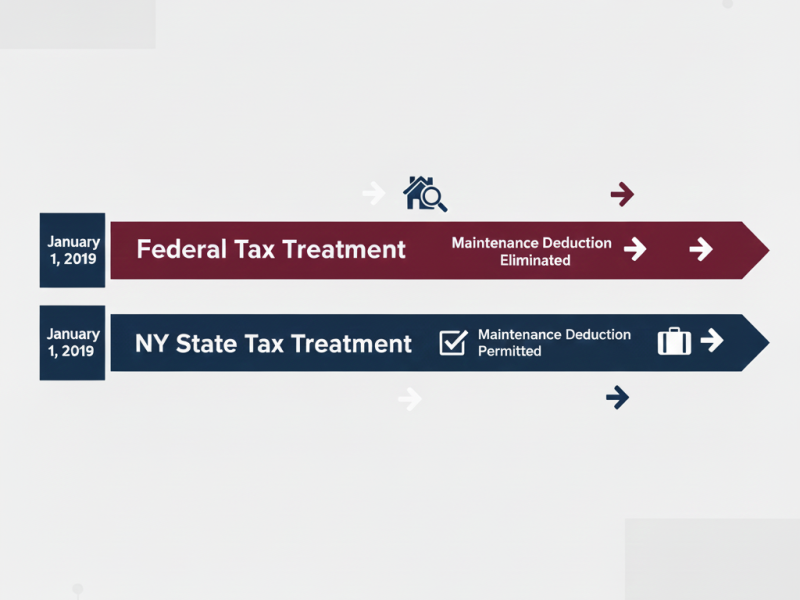
On your federal Form 1040, you report your income with no adjustment for maintenance. On your New York State Form IT-201, you need adjustments. If paying maintenance, subtract it from your Federal Adjusted Gross Income. If receiving maintenance, add it.
Many people miss these state-specific adjustments entirely, leading to incorrect state tax payments. Make sure your tax preparer understands that New York didn’t follow the federal tax law change.
The Real Financial Planning Challenge
This split tax treatment creates several practical challenges. First, you need to think about the actual after-tax cost and benefit, not just the headline number. That $36,000 maintenance figure from our example isn’t what either of you actually experiences financially.
Second, this affects how you structure your agreement. In mediation, couples can negotiate amounts that account for the federal tax change. Instead of simply applying the guideline formula, you can calculate an amount that splits the tax impact fairly rather than having the payor bear it entirely. That creative problem-solving doesn’t happen in litigation, where you’re stuck with whatever the formula produces.
If you’re the higher-earning spouse, plan for paying maintenance from after-tax dollars. If you’re the lower-earning spouse, remember you still pay New York State tax on maintenance—set aside roughly 4% to 6% of your maintenance payment for state tax.
Income Over the Cap: Where Financial Expertise Becomes Critical
This tax complexity becomes even more significant above the $228,000 formula cap. Maintenance on income above that threshold is discretionary, and the tax treatment matters when determining what’s fair.
If you’re earning $350,000, the formula applies to the first $228,000 of that amount. For the remaining $122,000, you’re negotiating what additional maintenance makes sense. The fact that it won’t be federally deductible is absolutely relevant. You might negotiate a lower percentage on above-cap income to account for the tax disadvantage. This is where understanding the actual after-tax cost becomes critical.
In litigation, this analysis doesn’t happen—you get a number, and you’re done. In mediation, we can model different scenarios, run the tax calculations, and help you understand the real financial impact before you commit.
Working Through the Numbers Together

The most productive approach in mediation is for both spouses to understand these tax realities from the beginning. Some couples calculate what the old tax rules would have produced, then figure out how to split the additional federal tax cost. Others focus on net spendable income—how much maintenance leaves both of you with enough to cover actual living expenses and build toward financial independence?
What you want to avoid is negotiating based on gross maintenance numbers without understanding the after-tax reality. That’s how people end up surprised six months later when the financial reality doesn’t match expectations.
Why This Demands More Than Generic Mediation
Every dollar of maintenance paid costs you more than a dollar when you account for the lost federal tax benefit. Every dollar received puts less than a dollar in your pocket after New York State taxes. The gap between the gross number and the net reality is typically 15% to 30% depending on your tax situation.
This complexity is exactly why working with a mediator who has genuine financial expertise matters. Many mediators apply the formula without helping couples understand the after-tax reality. With an MBA in finance, we help you model various scenarios, understand the tax implications of different structures, and explore creative solutions that account for this split tax treatment.
This isn’t a reason to avoid maintenance or to fight over every dollar. It’s information that helps you negotiate intelligently. When you understand the actual after-tax impact, you can have productive conversations about what amount actually accomplishes the goal—helping the lower-earning spouse maintain a reasonable standard of living while transitioning toward financial independence.
Navigating Complexity While Maintaining Control
You’re dealing with something genuinely complicated, and feeling confused is normal. But here’s what shouldn’t be normal: finalizing a maintenance agreement without understanding its real after-tax impact on both of you.
In litigation, that’s precisely what happens. The formula gets applied, agreements get drafted, and only later do people realize the actual financial burden differs significantly from expectations. In mediation, you maintain control over this analysis. We don’t just calculate the guideline amount and move on. We help you understand what that number means in take-home dollars.
If your income includes bonuses, stock options, or other variable compensation, this can make it even more complex. We can help you think through how to handle those elements fairly and sustainably. The goal isn’t just to reach an agreement—it’s to reach an agreement where both of you understand exactly what you’re committing to financially. That clarity allows you to move forward confidently, knowing the decisions you made together actually work in practice, not just on paper.

FAQs About Spousal Maintenance in New York
The Mediation Advantage for Maintenance Discussions
Throughout these FAQs, you’ve seen references to mediation as an alternative to litigation. In litigation, attorneys fight over what guidelines produce and argue about how factors apply. You’re spending tens of thousands on adversarial processes that often produce outcomes neither party accepts. For co-parents, this poisons the relationship foundation you need for years ahead.
In mediation, you’re working together to understand what the guidelines say, whether they fit your circumstances, and what alternatives might work better. When you combine that collaborative process with genuine financial expertise—the ability to model scenarios, calculate present values, analyze tax impacts, and structure creative solutions—you get agreements that are both fair and sustainable.
That’s what makes the difference between maintenance arrangements that work and ones that create ongoing conflict.
About the Authors – Divorce Mediators You Can Trust
Equitable Mediation Services is a trusted and nationally recognized provider of divorce mediation, serving couples exclusively in California, New Jersey, Washington, New York, Illinois, and Pennsylvania. Founded in 2008, this husband-and-wife team has successfully guided more than 1,000 couples through the complex divorce process, helping them reach amicable, fair, and thorough agreements that balance each of their interests and prioritizes their children’s well-being. All without involving attorneys if they so choose.
At the heart of Equitable Mediation are Joe Dillon, MBA, and Cheryl Dillon, CPC—two compassionate, experienced professionals committed to helping couples resolve divorce’s financial, emotional, and practical issues peacefully and with dignity.

Joe Dillon, MBA – Divorce Mediator & Negotiation Expert
As a seasoned Divorce Mediator with an MBA in Finance, Joe Dillon specializes in helping clients navigate complex parental and financial issues, including:
- Physical and legal custody
- Spousal support (alimony) and child support
- Equitable distribution and community property division
- Business ownership
- Retirement accounts, stock options, and RSUs
Joe’s unique blend of financial acumen, mediation expertise, and personal insight enables him to skillfully guide couples through complex divorce negotiations, reaching fair agreements that safeguard the family’s emotional and financial well-being.
He brings clarity and structure to even the most challenging negotiations, ensuring both parties feel heard, supported, and in control of their outcome. This approach has earned him a reputation as one of the most trusted names in alternative dispute resolution.

Cheryl Dillon, CPC – Certified Divorce Coach & Life Transitions Expert
Cheryl Dillon is a Certified Professional Coach (CPC) and the Divorce Coach at Equitable Mediation. She earned a bachelor’s degree in psychology and completed formal training at The Institute for Professional Excellence in Coaching (iPEC) – an internationally recognized leader in the field of coaching education.
Her unique blend of emotional intelligence, coaching expertise, and personal insight enables her to guide individuals through divorce’s emotional complexities compassionately.
Cheryl’s approach fosters improved communication, reduced conflict, and better decision-making, equipping clients to manage divorce’s challenges effectively. Because emotions have a profound impact on shaping the divorce process, its outcomes, and future well-being of all involved.
What We Offer: Flat-Fee, Full-Service Divorce Mediation
Equitable Mediation provides:
- Full-service divorce mediation with real financial expertise
- Convenient, online sessions via Zoom
- Unlimited sessions for one customized flat fee (no hourly billing surprises)
- Child custody and parenting plan negotiation
- Spousal support and asset division mediation
- Divorce coaching and emotional support
- Free and paid educational courses on the divorce process
Whether clients are facing financial complexities, looking to safeguard their children’s futures, or trying to protect everything they’ve worked hard to build, Equitable Mediation has the expertise to guide them towards the outcomes that matter most to them and their families.
Why Couples Choose Equitable Mediation
- 98% case resolution rate
- Trusted by over 1,000 families since 2008
- Subject-matter experts in the states in which they practice
- Known for confidential, respectful, and cost-effective processes
- Recommendations by therapists, financial planners, and former clients
Equitable Mediation Services operates in:
- California: San Francisco, San Diego, Los Angeles
- New Jersey: Bridgewater, Morristown, Short Hills
- Washington: Seattle, Bellevue, Kirkland
- New York: NYC, Long Island
- Illinois: Chicago, North Shore
- Pennsylvania: Philadelphia, Bucks County, Montgomery County, Pittsburgh, Allegheny County
Schedule a Free Info Call to learn if you’re a good candidate for divorce mediation with Joe and Cheryl.