One of the most potent tools in mediation work isn’t a persuasive argument or clever negotiation tactics. It’s a spreadsheet. More specifically, it’s the ability to model out what your financial life will actually look like under different maintenance scenarios over the next five to ten years. And if you live in New York City, that can be quite a challenge!
When couples negotiate maintenance in a New York divorce, they’re often arguing over snapshots rather than movies. One spouse says, “I need $3,000 a month.” The other says, “I can’t afford $3,000 a month.” But what you really need to understand is what happens over time—how income grows, expenses evolve, property division interacts with maintenance, and whether the path to financial independence is realistic.
Financial modeling transforms mediation from positional bargaining into collaborative problem-solving. This is precisely the kind of sophisticated financial analysis that litigation can’t accommodate and that many mediators lack the training to provide.
Multi-Year Cash Flow Projections

The foundation is creating realistic cash flow projections for both spouses, mapping income and expenses month by month for at least 5 years.
For the receiving spouse, start with current monthly expenses—housing, utilities, food, transportation, insurance, debt payments, and child-related costs. Then consider how those expenses might change. Will housing costs decrease? Will childcare costs drop when your youngest starts school?
For income, project forward. If you’re returning to work full-time once kids are in school, when does that happen, and what income can you expect? If you’re completing a certification, when does that change your earning capacity?
The paying spouse needs the same analysis. What are essential expenses post-divorce? How much income is genuinely available for maintenance?
When you lay out five years of monthly cash flow, patterns emerge. You can see where cash crunches will occur, when financial pressure eases, and whether proposed maintenance creates sustainable outcomes or predictable crises.
Modeling Maintenance Combined With Property Division
Maintenance and property division aren’t separate conversations—they’re deeply interconnected. A New York maintenance agreement that looks reasonable in isolation might create problems when combined with how you’re splitting assets.
Model several scenarios simultaneously. What happens if the receiving spouse gets the house with $200,000 in equity and no liquid assets, plus $2,500 monthly maintenance for four years? Compare that to getting $100,000 in investment accounts, $100,000 in retirement accounts, no house equity, with $3,000 monthly maintenance for three years.
Consider income from distributed assets. If you’re receiving $300,000 in investment accounts earning 4% annually, that’s $12,000 in income per year. Does that change what maintenance amount makes sense?
Look at liquidity carefully. One scenario might give you more total value, but it’s tied up in retirement accounts. Another provides less total value but more liquid assets. Which serves your needs better? The model shows you by projecting accessible cash flow, not just net worth.
This integrated financial modeling requires genuine expertise. With an MBA in finance, we can build these models rigorously. In litigation, you’re fighting over each piece separately rather than optimizing the complete financial picture.
Analyzing the Path to Self-Sufficiency
One of the most essential uses of financial modeling is testing whether the receiving spouse’s path to self-sufficiency is realistic. It’s easy to say, “I’ll get my nursing certification and earn $65,000 in three years.” It’s more complex to model whether you can actually afford school while covering expenses.
Start with the goal—what income level do you need to be self-supporting? Then work backward. What steps are required? How long does the program take? What’s a realistic timeline to rebuild your career?
Model the transition period. If you’re going to school part-time while working part-time, what’s your reduced income? How do expenses compare to income plus maintenance?
This modeling often reveals that proposed timelines are unrealistic. Maybe maintenance duration is based on “three years to get certified,” but the model shows you’ll need six months after certification to find the right job. When both spouses can see the projected path with real numbers, you’re both looking at what’s actually achievable.
Stress-Testing Your Assumptions
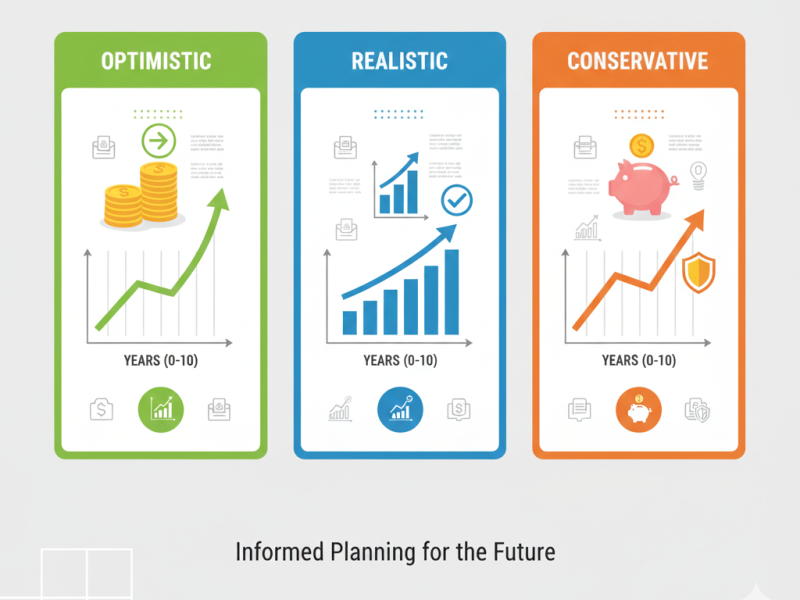
Financial modeling isn’t just about creating one projection—it’s about testing what happens if your assumptions are wrong. Life doesn’t unfold according to plan.
Create multiple scenarios. What if the paying spouse’s income doesn’t grow as expected? What if the receiving spouse’s return to work takes longer? What if investment returns are lower than assumed?
Model the optimistic scenario where everything goes better than expected, the pessimistic scenario where everything goes wrong, and the most likely scenario in the middle. If your maintenance agreement only works in the optimistic scenario, you might need different terms or adjustment mechanisms.
This stress-testing is particularly important for step-down provisions. If maintenance drops from $3,000 to $1,500 after two years based on expected income increase, model what happens if that increase doesn’t materialize.
How Objective Data Depersonalizes Emotional Discussions
The emotional charge around maintenance often comes from feeling unheard or disbelieved. When the receiving spouse says, “I can’t survive on less than $3,000 a month,” and the paying spouse responds, “That’s ridiculous,” you’re at an impasse.
Financial modeling changes that dynamic. Instead of arguing about whether $3,000 is reasonable, you’re looking at a spreadsheet showing monthly expenses, income sources, and resulting cash flow. If the model shows that the receiving spouse will run through their liquid assets and be unable to pay their mortgage in year three, that’s not drama; it’s math.
Couples go from heated argument to calm problem-solving when we put projections on the screen. Instead of “you’re being unreasonable,” it becomes “the model shows a cash crunch in year two, so what can we adjust?”
The paying spouse benefits from this objectivity, too. When you can show through modeling that you genuinely can’t afford the requested amount, it’s much more compelling than just saying “I can’t afford it.”
Making Informed Decisions Together

The real power of financial modeling is that it allows both spouses to make truly informed decisions. You’re seeing plausible scenarios based on reasonable assumptions, and you can adjust those assumptions to test different possibilities. It’s not just for Wall Street power brokers.
We often spend significant time together building financial models. Both spouses see the inputs, understand the assumptions, and can suggest changes. The modeling reveals trade-offs more clearly. Maybe if the receiving spouse takes a larger share of the property, they can afford to accept lower maintenance. Or the paying spouse can afford higher maintenance if the duration is shorter.
Sometimes the modeling reveals you need to think differently. Maybe the guideline maintenance amount creates long-term problems, but a hybrid approach works. You wouldn’t necessarily discover that creative solution through negotiation alone.
Why This Level of Financial Analysis Matters
Financial modeling in mediation isn’t about replacing human judgment with cold calculation. It’s about giving that judgment a solid foundation in information.
What the modeling does is move you from arguing about competing stories to solving a shared problem. The financial projections help you see whether what you’re considering will actually work.
Here’s what’s critical: this kind of sophisticated financial modeling requires genuine financial expertise. Many mediators come from legal or mental health backgrounds and don’t have the training to build multi-year cash flow projections, model the interaction between property division and maintenance, or analyze paths to self-sufficiency with this level of rigor.
We actively bring this financial modeling capability to the mediation process. We actually build the models, run the scenarios, and show you the numbers. That’s the difference between facilitation and active guidance—between generic mediation and working with someone who has both mediation skills and financial expertise.
In litigation, this collaborative financial modeling doesn’t happen. You’re fighting over positions rather than exploring scenarios together. Competing financial experts might prepare projections designed to support adversarial positions, not to help you find workable solutions collaboratively.
Couples who invest time in serious financial modeling reach stronger agreements. They understand what they’re agreeing to, they’ve tested it against various scenarios, and they’re confident it will hold up. The spreadsheets turn what often feels like an impossible negotiation into a problem you can solve together—with precise numbers, realistic projections, and a shared understanding of what the future holds.

FAQs About Spousal Maintenance in New York
The Mediation Advantage for Maintenance Discussions
Throughout these FAQs, you’ve seen references to mediation as an alternative to litigation. In litigation, attorneys fight over what guidelines produce and argue about how factors apply. You’re spending tens of thousands on adversarial processes that often produce outcomes neither party accepts. For co-parents, this poisons the relationship foundation you need for years ahead.
In mediation, you’re working together to understand what the guidelines say, whether they fit your circumstances, and what alternatives might work better. When you combine that collaborative process with genuine financial expertise—the ability to model scenarios, calculate present values, analyze tax impacts, and structure creative solutions—you get agreements that are both fair and sustainable.
That’s what makes the difference between maintenance arrangements that work and ones that create ongoing conflict.
About the Authors – Divorce Mediators You Can Trust
Equitable Mediation Services is a trusted and nationally recognized provider of divorce mediation, serving couples exclusively in California, New Jersey, Washington, New York, Illinois, and Pennsylvania. Founded in 2008, this husband-and-wife team has successfully guided more than 1,000 couples through the complex divorce process, helping them reach amicable, fair, and thorough agreements that balance each of their interests and prioritizes their children’s well-being. All without involving attorneys if they so choose.
At the heart of Equitable Mediation are Joe Dillon, MBA, and Cheryl Dillon, CPC—two compassionate, experienced professionals committed to helping couples resolve divorce’s financial, emotional, and practical issues peacefully and with dignity.

Joe Dillon, MBA – Divorce Mediator & Negotiation Expert
As a seasoned Divorce Mediator with an MBA in Finance, Joe Dillon specializes in helping clients navigate complex parental and financial issues, including:
- Physical and legal custody
- Spousal support (alimony) and child support
- Equitable distribution and community property division
- Business ownership
- Retirement accounts, stock options, and RSUs
Joe’s unique blend of financial acumen, mediation expertise, and personal insight enables him to skillfully guide couples through complex divorce negotiations, reaching fair agreements that safeguard the family’s emotional and financial well-being.
He brings clarity and structure to even the most challenging negotiations, ensuring both parties feel heard, supported, and in control of their outcome. This approach has earned him a reputation as one of the most trusted names in alternative dispute resolution.

Cheryl Dillon, CPC – Certified Divorce Coach & Life Transitions Expert
Cheryl Dillon is a Certified Professional Coach (CPC) and the Divorce Coach at Equitable Mediation. She earned a bachelor’s degree in psychology and completed formal training at The Institute for Professional Excellence in Coaching (iPEC) – an internationally recognized leader in the field of coaching education.
Her unique blend of emotional intelligence, coaching expertise, and personal insight enables her to guide individuals through divorce’s emotional complexities compassionately.
Cheryl’s approach fosters improved communication, reduced conflict, and better decision-making, equipping clients to manage divorce’s challenges effectively. Because emotions have a profound impact on shaping the divorce process, its outcomes, and future well-being of all involved.
What We Offer: Flat-Fee, Full-Service Divorce Mediation
Equitable Mediation provides:
- Full-service divorce mediation with real financial expertise
- Convenient, online sessions via Zoom
- Unlimited sessions for one customized flat fee (no hourly billing surprises)
- Child custody and parenting plan negotiation
- Spousal support and asset division mediation
- Divorce coaching and emotional support
- Free and paid educational courses on the divorce process
Whether clients are facing financial complexities, looking to safeguard their children’s futures, or trying to protect everything they’ve worked hard to build, Equitable Mediation has the expertise to guide them towards the outcomes that matter most to them and their families.
Why Couples Choose Equitable Mediation
- 98% case resolution rate
- Trusted by over 1,000 families since 2008
- Subject-matter experts in the states in which they practice
- Known for confidential, respectful, and cost-effective processes
- Recommendations by therapists, financial planners, and former clients
Equitable Mediation Services operates in:
- California: San Francisco, San Diego, Los Angeles
- New Jersey: Bridgewater, Morristown, Short Hills
- Washington: Seattle, Bellevue, Kirkland
- New York: NYC, Long Island
- Illinois: Chicago, North Shore
- Pennsylvania: Philadelphia, Bucks County, Montgomery County, Pittsburgh, Allegheny County
Schedule a Free Info Call to learn if you’re a good candidate for divorce mediation with Joe and Cheryl.