When negotiating alimony, the conversation typically centers on the amount and duration. But there’s another crucial question that often gets overlooked: how will this affect your taxes?
If you’re thinking, “Well, I’ll pay taxes on alimony I receive and get a deduction for alimony I pay,” I need to stop you right there. That’s how it used to work, but how alimony gets treated for tax purposes changed dramatically in 2019. And this change fundamentally altered how couples should think about alimony negotiations.
For any divorce finalized after December 31, 2018, alimony is no longer tax-deductible for the person paying it, and it’s no longer taxable income for the person receiving it at the Federal level. This is the opposite of how it worked for decades, and the shift has massive implications for how you should structure your divorce agreement.
As a divorce mediator with an MBA in Finance, I help couples navigate these tax implications every day. While I can’t give you tax or legal advice, I can show you how to think about the tax landscape and explore creative structuring options that might save both of you money.
Please note: The financial examples in this post are for illustration purposes only and use simplified scenarios with round numbers to demonstrate concepts. Every divorce situation is unique, with different income levels, expenses, family circumstances, and financial complexities. These examples are not predictions of what you should expect in your specific case. I’m not a lawyer and cannot provide legal advice or tell you what alimony amount you’ll receive or pay.
What Changed in 2019 and Why It Matters
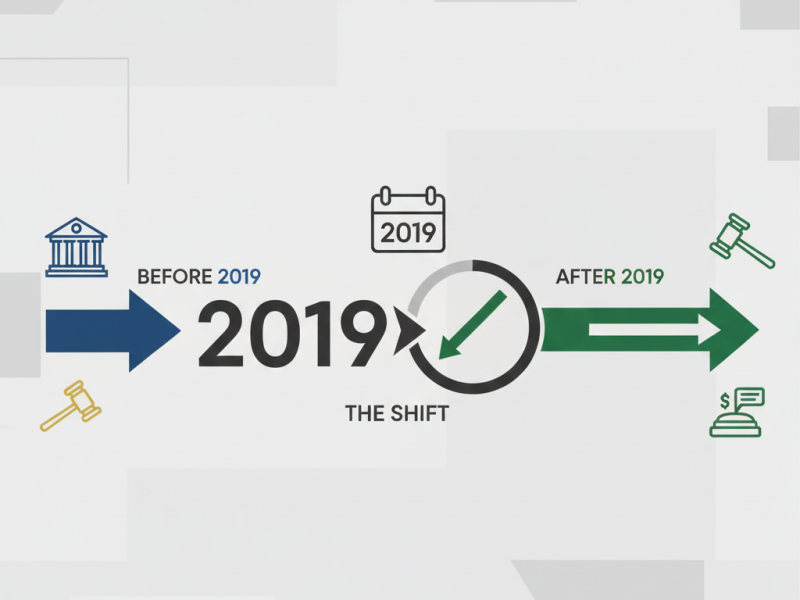
Before 2019, the tax treatment of alimony was straightforward: the person paying could deduct it from their taxable income, and the person receiving had to report it as taxable income. This created tax efficiency by shifting income from a higher earner (usually in a higher tax bracket) to a lower earner (usually in a lower tax bracket).
Let’s say before 2019, someone in the 35% tax bracket paid $60,000 in annual alimony to an ex-spouse in the 15% tax bracket. The payor’s after-tax cost was only $39,000, reflecting the deduction ($60,000 minus $21,000 in tax savings). The recipient paid about $9,000 in taxes on the $60,000, netting $51,000. Between them, they paid $9,000 in total taxes on the $60,000 transfer.
Now, for divorces finalized after 2018, alimony is no longer deductible or taxable at the Federal level. Using the same example, someone in the 35% tax bracket paying $60,000 in alimony now pays from after-tax dollars—meaning they need to earn about $92,000 pre-tax to have $60,000 available for alimony after paying their own taxes. The recipient receives the full $60,000 tax-free, which is better for them. But the payor’s actual cost increased from $60,000 to $92,000—a 53% increase in the pre-tax income required.
This change means there are fewer after-tax dollars available to fund two households. That’s just mathematical reality. So couples need to think more creatively about structuring their agreements.
How This Changes Alimony Negotiations

Because alimony is no longer deductible, the person paying it has less cash available than they would have under the old rules. This often means alimony amounts need to be structured differently to make the math work.
In mediation, I help couples understand what income is actually available after taxes. If someone earns $250,000 per year, after federal, state, and payroll taxes, they might net $155,000 annually, or about $13,000 monthly. That’s what’s available for their own living expenses and alimony.
Let’s work through a complete example. One spouse earns $200,000 annually (about $130,000 after tax, or $11,000 monthly). The other earns $50,000 annually (about $40,000 after tax, or $3,300 monthly). The higher earner needs $6,000 monthly for reasonable expenses. The lower earner needs $5,500 monthly. Under current tax treatment, if we structure alimony at $2,500 per month, the payor has $11,000 available, pays $2,500 in alimony from after-tax dollars, and has $8,500 remaining (enough to cover their $6,000 in expenses, with $2,500 left for savings). The recipient has $3,300 from earnings plus $2,500 in tax-free alimony, totaling $5,800 monthly—just enough to meet the $5,500 need with a small cushion.
We build detailed after-tax cash flow analyses for both of you under different alimony scenarios. What does your monthly budget look like with $2,000 monthly in alimony versus $3,500 monthly? How does each scenario affect both of your abilities to save for retirement or handle unexpected expenses?
This after-tax analysis is crucial because gross income figures can be misleading. Someone might appear to be able to easily afford $6,000 in monthly alimony based on their $250,000 salary. Still, when you account for taxes taking $95,000 and their own reasonable expenses of $7,000 monthly ($84,000 annually), the actual available amount for alimony is only $71,000 annually, or about $6,000 monthly.
Property Settlement Versus Alimony Characterization
Here’s where tax efficiency gets interesting: while alimony isn’t deductible anymore, property transfers in divorce are generally tax-free between spouses. This creates opportunities to structure agreements differently.
Let’s say, under a traditional approach, you might negotiate $5,000 in monthly alimony for 10 years—a total of $600,000. Because the payor can’t deduct it, they need to earn roughly $920,000 pre-tax over those 10 years to have $600,000 available after their own taxes (assuming a 35% effective tax rate). The recipient receives $600,000 tax-free.
But what if instead, the lower-earning spouse receives a larger share of retirement accounts or other assets? Transferring $400,000 in additional retirement assets as part of the property settlement is generally tax-free at the time of transfer. The recipient then has a substantial asset base that can generate income or be drawn down over time. Meanwhile, alimony could be reduced to $2,000 monthly for 10 years ($240,000 total), requiring the payor to earn only $370,000 pre-tax to fund that obligation.
Let’s compare: Traditional structure requires the payor to earn $920,000 pre-tax. The hybrid structure (additional $400,000 in assets plus $240,000 in alimony) requires the payor to earn $370,000 pre-tax, plus they give up $400,000 more in assets. But depending on the overall asset division and each person’s needs, this hybrid approach might work better for both people.
This is where the analysis gets sophisticated. We need to consider the time value of money (getting $400,000 now versus $5,000 monthly for 10 years), the investment returns those assets might generate, the tax treatment when funds are eventually withdrawn from retirement accounts, and each person’s liquidity needs.
I help couples model these different scenarios. What if we reduce alimony by $2,500 per month while shifting an additional $250,000 in retirement assets to the recipient? What does that mean for each person’s financial picture over 10 years, including investment growth?
Other Creative Structuring Options

Beyond the property settlement versus alimony question, there are other ways to structure agreements for tax efficiency:
Front-loading alimony: Maybe $4,000 monthly for five years works better than $2,500 monthly for eight years, depending on each person’s tax situation and the recipient’s timeline for becoming self-supporting.
Step-down structures: Perhaps alimony starts at $4,500 monthly when the recipient needs it most, then steps down to $3,000 monthly after three years, then $1,500 monthly for the final three years as they build their own income.
Lump-sum payments: In some situations, a single lump-sum payment of $200,000 (treated as a property settlement, not alimony) might make more sense than $3,000 per month for 5.5 years.
Hybrid approach: Combining $2,000 monthly in alimony with an additional $150,000 in a property settlement might optimize the overall financial outcome for both of you compared to $4,000 monthly in alimony alone.
The key is running the numbers for each structure. What’s the total after-tax cost to the payor? What’s the total after-tax benefit to the recipient? Which structure maximizes the dollars available to both of you?
Why Working with Tax Professionals Matters
Tax situations are complex, and everyone’s circumstances are different. The examples I’ve given are simplified to illustrate concepts. Your actual tax situation depends on your income level, state taxes, deductions, retirement account types, and many other factors.
That’s why I always encourage couples to consult with a tax professional—a CPA or tax attorney—to review any proposed alimony structure before finalizing it. In mediation, I build financial models and explore creative structuring options, identifying which approaches are most likely to work. Then you can take those scenarios to your tax advisor to verify the specific implications for your situation and ensure we’ve optimized the structure correctly.
As a divorce mediator with an MBA in Finance, I bring financial analysis skills to identify the right questions to ask and the most effective structures to explore with your tax advisor. I help you understand the trade-offs between different approaches and model the long-term implications of each option with detailed projections.
Moving Forward with Smart Tax Planning
The tax implications of alimony are too significant to ignore. The 2018 changes mean you need to approach alimony negotiations differently than couples did even a few years ago—and differently than you might expect based on advice from friends or family who divorced under the old rules.
In court, there’s no time for this kind of sophisticated analysis. A judge isn’t going to explore whether giving you an extra $300,000 in retirement assets plus $2,000 monthly in alimony works better than $4,500 monthly in alimony alone. You’ll get a standard alimony order based on income and need, with no consideration of tax-efficient structuring. You’d both walk away, leaving money on the table that could have been preserved through smarter structuring.
In mediation, we can conduct a detailed financial analysis to understand the after-tax implications of different structures and identify approaches that work for both of you. We can explore whether property settlements, hybrid structures, or creative alimony arrangements might leave both of you better off than a standard approach.
This is precisely where financial complexity expertise makes the most significant difference. With an MBA in Finance and experience working through these specific tax questions with hundreds of couples since the 2018 changes, I can help you understand not just what you’re paying or receiving, but what it really costs in after-tax dollars and how to structure your agreement to maximize the value for both of you.
We don’t just look at this year’s taxes. We project forward—what happens when tax brackets change, when retirement accounts get distributed, when income levels shift? Building that future-focused tax planning into your agreement from the start means you’re not surprised five years from now when a distribution you didn’t anticipate creates a tax bill you didn’t expect.
That sophisticated analysis, combined with the flexibility to structure creative solutions, is only possible in mediation. You’re not limited to standard alimony payments. You can design hybrid approaches tailored to your specific financial and tax situation, maximizing the after-tax dollars available to both of you.
Suppose you’re facing alimony negotiations in New Jersey. In that case, understanding the tax implications and exploring tax-efficient structures can make a difference of tens of thousands of dollars over the life of your agreement. You deserve an approach that combines financial expertise with creative problem-solving to help both of you keep more of what you’ve earned.

FAQs About Alimony in New Jersey
About the Authors – Divorce Mediators You Can Trust
Equitable Mediation Services is a trusted and nationally recognized provider of divorce mediation, serving couples exclusively in California, New Jersey, Washington, New York, Illinois, and Pennsylvania. Founded in 2008, this husband-and-wife team has successfully guided more than 1,000 couples through the complex divorce process, helping them reach amicable, fair, and thorough agreements that balance each of their interests and prioritizes their children’s well-being. All without involving attorneys if they so choose.
At the heart of Equitable Mediation are Joe Dillon, MBA, and Cheryl Dillon, CPC—two compassionate, experienced professionals committed to helping couples resolve divorce’s financial, emotional, and practical issues peacefully and with dignity.

Joe Dillon, MBA – Divorce Mediator & Negotiation Expert
As a seasoned Divorce Mediator with an MBA in Finance, Joe Dillon specializes in helping clients navigate complex parental and financial issues, including:
- Physical and legal custody
- Spousal support (alimony) and child support
- Equitable distribution and community property division
- Business ownership
- Retirement accounts, stock options, and RSUs
Joe’s unique blend of financial acumen, mediation expertise, and personal insight enables him to skillfully guide couples through complex divorce negotiations, reaching fair agreements that safeguard the family’s emotional and financial well-being.
He brings clarity and structure to even the most challenging negotiations, ensuring both parties feel heard, supported, and in control of their outcome. This approach has earned him a reputation as one of the most trusted names in alternative dispute resolution.

Cheryl Dillon, CPC – Certified Divorce Coach & Life Transitions Expert
Cheryl Dillon is a Certified Professional Coach (CPC) and the Divorce Coach at Equitable Mediation. She earned a bachelor’s degree in psychology and completed formal training at The Institute for Professional Excellence in Coaching (iPEC) – an internationally recognized leader in the field of coaching education.
Her unique blend of emotional intelligence, coaching expertise, and personal insight enables her to guide individuals through divorce’s emotional complexities compassionately.
Cheryl’s approach fosters improved communication, reduced conflict, and better decision-making, equipping clients to manage divorce’s challenges effectively. Because emotions have a profound impact on shaping the divorce process, its outcomes, and future well-being of all involved.
What We Offer: Flat-Fee, Full-Service Divorce Mediation
Equitable Mediation provides:
- Full-service divorce mediation with real financial expertise
- Convenient, online sessions via Zoom
- Unlimited sessions for one customized flat fee (no hourly billing surprises)
- Child custody and parenting plan negotiation
- Spousal support and asset division mediation
- Divorce coaching and emotional support
- Free and paid educational courses on the divorce process
Whether clients are facing financial complexities, looking to safeguard their children’s futures, or trying to protect everything they’ve worked hard to build, Equitable Mediation has the expertise to guide them towards the outcomes that matter most to them and their families.
Why Couples Choose Equitable Mediation
- 98% case resolution rate
- Trusted by over 1,000 families since 2008
- Subject-matter experts in the states in which they practice
- Known for confidential, respectful, and cost-effective processes
- Recommendations by therapists, financial planners, and former clients
Equitable Mediation Services operates in:
- California: San Francisco, San Diego, Los Angeles
- New Jersey: Bridgewater, Morristown, Short Hills
- Washington: Seattle, Bellevue, Kirkland
- New York: NYC, Long Island
- Illinois: Chicago, North Shore
- Pennsylvania: Philadelphia, Bucks County, Montgomery County, Pittsburgh, Allegheny County
Schedule a Free Info Call to learn if you’re a good candidate for divorce mediation with Joe and Cheryl.