When you’re negotiating alimony, it’s easy to focus entirely on the present: what income is available now, what expenses you have now, what budget makes sense now. But if you’re in your 40s, 50s, or 60s, there’s another conversation that’s just as important: what happens when you retire?
Retirement isn’t some distant abstraction anymore. It’s something you’ll likely need to plan for within the next 10 to 25 years. And the alimony decisions you make today will directly affect your retirement security—for both of you.
Here’s what makes this complicated: retirement affects alimony in multiple ways. Retirement assets accumulated during marriage must be divided. There’s Social Security that both of you will eventually receive. There’s the question of what happens to alimony when the payor retires. And there’s the question of whether each of you will have enough to live on in retirement.
As a divorce mediator with an MBA in Finance, I help couples think through these interconnected questions every day. This is where mediation’s flexibility becomes invaluable—you can structure agreements that work for the long term, not just for today.
Please note: The financial examples in this post are for illustration purposes only and use simplified scenarios with round numbers to demonstrate concepts. Every divorce situation is unique, with different income levels, expenses, family circumstances, and financial complexities. These examples are not predictions of what you should expect in your specific case. I’m not a lawyer and cannot provide legal advice or tell you what alimony amount you’ll receive or pay.
Securing the Safety Net: Why Retirement Planning and Alimony Can’t Be Separated

I worked with a couple who had been married for 24 years. He was 54, earning $180,000 annually, and she was 50, earning $40,000 after years out of the workforce. Initially, they considered open durational alimony of $5,000 monthly based on current incomes and expenses. His after-tax income was about $120,000 annually ($10,000 monthly), and he needed $6,000 monthly for expenses, leaving $4,000 available. She had $2,800 in after-tax income and needed $5,500. The $2,700 gap suggested $2,500 to $3,000 monthly in alimony, but they were thinking $5,000 to maintain her marital lifestyle.
But we looked ahead: he planned to retire at 67, which was 13 years away. His income would drop to about $65,000 in pension and Social Security (roughly $5,000 monthly after tax). Could he afford $5,000 monthly in alimony on retirement income when his own expenses would be at least $4,500 monthly? Not realistically. Without addressing this timeline, they’d be setting up an inevitable conflict years down the road.
So we structured it differently. Alimony would be $4,500 per month until his retirement at 67, then reduced to $1,500 per month for an additional 10 years. Here’s why that $1,500 mattered.
We projected that their Social Security benefits at retirement would differ by approximately $3,000 monthly—he’d receive about $3,500 based on his higher lifetime earnings. In comparison, she’d receive about $2,200 (including spousal benefits based on his record). By continuing alimony at $1,500 per month, we essentially narrowed that Social Security gap to $1,500 per month. Combined with splitting their $750,000 in retirement savings equally ($375,000 each), she’d have her own retirement assets to draw on without depleting them faster to compensate for lower Social Security benefits.
We modeled their financial situations over the first 10 years of retirement. He’d have $5,000 monthly from retirement income plus $1,500 from drawing down his $375,000 in retirement assets (about 5% annually). She’d have $2,200 from Social Security, $1,500 in alimony, plus $1,800 from her own $375,000 in retirement assets. Both could maintain reasonable lifestyles through age 77.
That’s coordinating retirement planning with alimony. You’re not just solving for today—you’re solving for the next 20 or 30 years.
How Retirement Gets Handled in New Jersey
In New Jersey, since 2014, reaching full retirement age (currently age 67 for most people) creates a valid basis for modifying or terminating alimony. Retirement at full retirement age is presumed to be in good faith, not an attempt to avoid paying support. This means the payor isn’t forced to work indefinitely.
But what should happen to alimony when someone retires? Should it end completely? Reduce? Continue? These are questions you decide in mediation.
If you don’t address retirement in your alimony agreement, you’re setting up future problems. The payor might assume alimony ends at retirement. The recipient might assume it continues unchanged. Years from now, you’re back in conflict when you could have resolved this clearly during the divorce.
The Role of Retirement Asset Division
The retirement assets you’re dividing aren’t separate from the alimony conversation. They’re deeply connected.
Let’s work through a concrete example. You accumulated $800,000 in retirement accounts during marriage—$500,000 in one spouse’s 401(k) and $300,000 in the other’s. How those get divided affects what’s reasonable for alimony, both now and in retirement.
Scenario 1: Divide retirement assets 50/50. Each person has $400,000 growing for retirement. At a 6% return over 15 years until retirement, that grows to about $950,000 each. Drawing 4% annually in retirement yields about $3,200 per person per month.
Scenario 2: Split them 60/40 in favor of the lower-earning spouse. They have $480,000, and the higher earner has $320,000. At retirement, that’s $1,150,000 versus $770,000. The lower earner can draw $3,800 monthly, and the higher earner can draw $2,600 monthly. This larger asset base for the lower earner might reduce the need for alimony to continue at the same level through retirement, or eliminate it if combined with other income sources.
I help couples model these scenarios with real numbers. What does each person’s retirement income look like under different asset divisions? How does that affect what’s reasonable for alimony? Can a larger share of retirement assets offset lower or shorter-term alimony?
This integrated financial planning occurs in mediation but is often overlooked when these issues are addressed separately in court.
How Social Security Factors Into the Equation
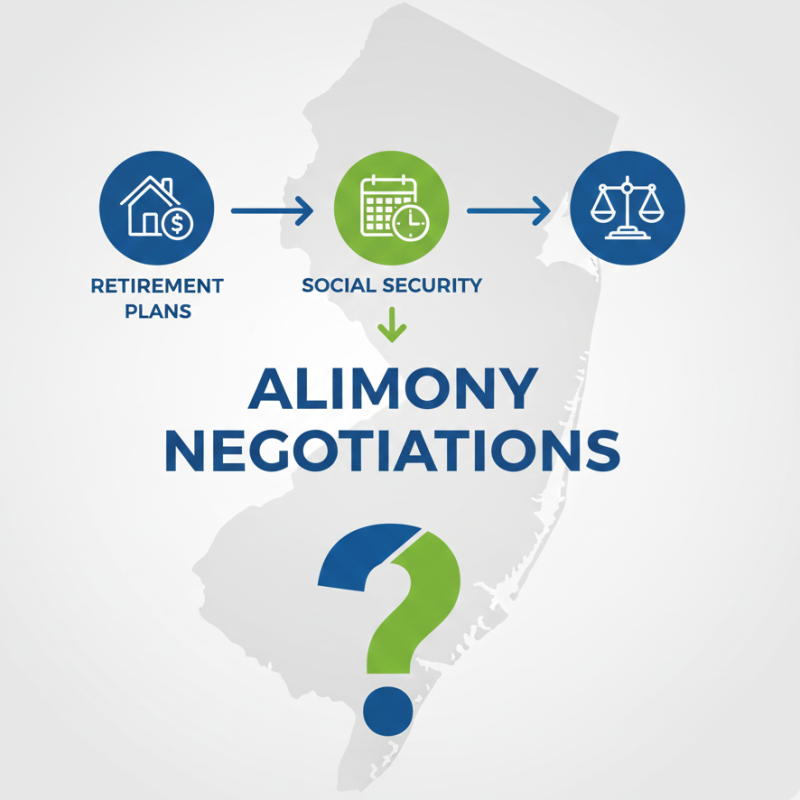
Social Security is another piece that affects alimony negotiations.
If you were married at least 10 years, you may be entitled to Social Security benefits based on your ex-spouse’s earnings record. You can receive up to 50% of their benefit if it’s higher than your own. This doesn’t reduce what they receive.
Let’s say the higher earner will receive $3,200 in Social Security benefits per month at full retirement age. The lower earner’s own benefit will only be $1,100 monthly, but they can claim $1,600 monthly (50% of their ex-spouse’s benefit) based on their ex-spouse’s record. That additional $500 monthly in guaranteed retirement income affects what’s reasonable for alimony after retirement.
Here’s a complete scenario: One spouse receives $3,200 monthly in Social Security, has $400,000 in retirement assets providing $1,300 monthly (4% draw), and a pension providing $2,000 monthly. Total retirement income: $6,500 monthly. The other spouse receives $1,600 monthly in Social Security (spousal benefit) and has $400,000 in retirement assets that provide $1,300 monthly. Total: $2,900 monthly. The gap is $3,600 monthly. This suggests alimony might need to continue at $2,500 to $3,000 monthly in retirement to ensure both people can maintain reasonable lifestyles.
In mediation, we factor this into financial modeling. We’re examining all sources of retirement income—Social Security, pensions, withdrawals from retirement accounts, and potential alimony—to build each person’s complete retirement picture.
Structuring Alimony to Coordinate with Retirement
Once you understand how retirement assets and Social Security factor in, you can structure alimony thoughtfully. Here are approaches I’ve used with couples that work well:
Step-down at retirement: Alimony continues until retirement, but reduces significantly when the payor retires—maybe $5,000 monthly during working years, dropping to $2,000 monthly after retirement for 10 years.
Termination at retirement age: Alimony ends when the payor reaches full retirement age, but the recipient receives a larger share of retirement assets to offset earlier termination. For example, alimony of $4,000 per month for 12 years (until retirement), with the recipient receiving $500,000 of the $800,000 in retirement assets instead of splitting 50/50.
Continued with adjustments: Alimony continues through retirement, but at a level sustainable on retirement income. Maybe $3,500 monthly during working years and $2,500 monthly after retirement, based on modeling both people’s complete retirement income.
Hybrid approaches: Higher alimony for a set number of years, then reduces to a lower long-term amount sustainable through retirement. Perhaps $5,500 monthly for 8 years, then $2,000 monthly for another 12 years through retirement.
The key is modeling what each approach means for both people’s long-term financial security. What does your lifestyle look like at age 70 under each scenario? At 75? At 80?
This is where my finance background makes a difference. I build detailed projections showing income from all sources—retirement accounts, pensions, Social Security, and alimony—and help you see which structures actually work long term.
Special Considerations for Longer Marriages
If you’ve been married 20 years or longer, retirement coordination becomes even more critical because you’re potentially talking about open durational alimony that could continue for decades.
At this stage in life, retirement might be only 10 or 15 years away. The decisions you make about alimony today will directly affect what retirement looks like for both of you.
These longer marriages often involve substantial retirement assets—maybe $1 million or more accumulated over decades. A 55-year-old couple with $1.2 million in retirement assets has 12 years until retirement at 67. At 6% growth, that’s $2.4 million to divide at retirement. How that gets divided is just as crucial as the alimony terms, and the two decisions should be made together.
Building Retirement Security Through Strategic Planning

Retirement planning and alimony aren’t separate conversations—they’re interconnected pieces of your long-term financial security. The alimony agreement you negotiate today will affect what your life looks like at 65, 70, and beyond. The difference between a well-coordinated plan and one that ignores retirement can be hundreds of thousands of dollars in retirement security.
If you went to court, you’d face a judge making decisions in a brief hearing with limited information. They’d issue a standard alimony order based on current circumstances, maybe with a generic provision about retirement modification rights. You wouldn’t get customized, integrated planning that coordinates alimony with retirement asset division, Social Security timing, and long-term cash flow projections. You’d be left hoping your agreement still makes sense 15 years from now when retirement arrives.
In mediation, we can perform sophisticated financial modeling to show exactly what each person’s retirement looks like under different scenarios. We can coordinate alimony terms with asset division to optimize both people’s long-term security. We can structure agreements that reflect your specific retirement timeline, whether that’s 62 or 70.
This is precisely where financial complexity expertise makes the most significant difference. With an MBA in Finance and experience working through these specific retirement coordination questions with hundreds of couples, I can help you understand not just what alimony looks like today, but how it integrates with retirement assets, Social Security, pensions, and long-term cash flow. We model your complete financial picture at age 65, 70, and 75 to ensure the agreement we’re building today actually works when retirement arrives.
That future-focused planning approach means you won’t be surprised when retirement comes. You’ve already built in how alimony is calculated, how assets are distributed, and how Social Security affects the picture. You understand what happens in year 10 when retirement hits, in year 15 when drawing down assets, and in year 20 when cash flow changes. You’ve planned for it all from the start.
Retirement planning isn’t one-size-fits-all. Maybe you want to retire at 62 or work until 70. Perhaps you have a pension, or you don’t. You might have $400,000 in retirement assets or $1.5 million. These specifics matter enormously for determining the appropriate alimony structure and how it coordinates with your retirement planning.
If you’re facing alimony negotiations in New Jersey and retirement is on your horizon, mediation with sophisticated financial expertise helps you build an agreement that works not just for today but for the next 20 or 30 years. You deserve an approach that integrates all the pieces—alimony, retirement assets, Social Security, pensions—into a comprehensive plan that gives you both security and clarity for the decades ahead.

FAQs About Alimony in New Jersey
About the Authors – Divorce Mediators You Can Trust
Equitable Mediation Services is a trusted and nationally recognized provider of divorce mediation, serving couples exclusively in California, New Jersey, Washington, New York, Illinois, and Pennsylvania. Founded in 2008, this husband-and-wife team has successfully guided more than 1,000 couples through the complex divorce process, helping them reach amicable, fair, and thorough agreements that balance each of their interests and prioritizes their children’s well-being. All without involving attorneys if they so choose.
At the heart of Equitable Mediation are Joe Dillon, MBA, and Cheryl Dillon, CPC—two compassionate, experienced professionals committed to helping couples resolve divorce’s financial, emotional, and practical issues peacefully and with dignity.

Joe Dillon, MBA – Divorce Mediator & Negotiation Expert
As a seasoned Divorce Mediator with an MBA in Finance, Joe Dillon specializes in helping clients navigate complex parental and financial issues, including:
- Physical and legal custody
- Spousal support (alimony) and child support
- Equitable distribution and community property division
- Business ownership
- Retirement accounts, stock options, and RSUs
Joe’s unique blend of financial acumen, mediation expertise, and personal insight enables him to skillfully guide couples through complex divorce negotiations, reaching fair agreements that safeguard the family’s emotional and financial well-being.
He brings clarity and structure to even the most challenging negotiations, ensuring both parties feel heard, supported, and in control of their outcome. This approach has earned him a reputation as one of the most trusted names in alternative dispute resolution.

Cheryl Dillon, CPC – Certified Divorce Coach & Life Transitions Expert
Cheryl Dillon is a Certified Professional Coach (CPC) and the Divorce Coach at Equitable Mediation. She earned a bachelor’s degree in psychology and completed formal training at The Institute for Professional Excellence in Coaching (iPEC) – an internationally recognized leader in the field of coaching education.
Her unique blend of emotional intelligence, coaching expertise, and personal insight enables her to guide individuals through divorce’s emotional complexities compassionately.
Cheryl’s approach fosters improved communication, reduced conflict, and better decision-making, equipping clients to manage divorce’s challenges effectively. Because emotions have a profound impact on shaping the divorce process, its outcomes, and future well-being of all involved.
What We Offer: Flat-Fee, Full-Service Divorce Mediation
Equitable Mediation provides:
- Full-service divorce mediation with real financial expertise
- Convenient, online sessions via Zoom
- Unlimited sessions for one customized flat fee (no hourly billing surprises)
- Child custody and parenting plan negotiation
- Spousal support and asset division mediation
- Divorce coaching and emotional support
- Free and paid educational courses on the divorce process
Whether clients are facing financial complexities, looking to safeguard their children’s futures, or trying to protect everything they’ve worked hard to build, Equitable Mediation has the expertise to guide them towards the outcomes that matter most to them and their families.
Why Couples Choose Equitable Mediation
- 98% case resolution rate
- Trusted by over 1,000 families since 2008
- Subject-matter experts in the states in which they practice
- Known for confidential, respectful, and cost-effective processes
- Recommendations by therapists, financial planners, and former clients
Equitable Mediation Services operates in:
- California: San Francisco, San Diego, Los Angeles
- New Jersey: Bridgewater, Morristown, Short Hills
- Washington: Seattle, Bellevue, Kirkland
- New York: NYC, Long Island
- Illinois: Chicago, North Shore
- Pennsylvania: Philadelphia, Bucks County, Montgomery County, Pittsburgh, Allegheny County
Schedule a Free Info Call to learn if you’re a good candidate for divorce mediation with Joe and Cheryl.