When you’re working through Illinois maintenance calculations, you might run the numbers using the formula—33.3% of the paying spouse’s net income minus 25% of the receiving spouse’s net income—and think you’re done. But there’s a second step that can dramatically change the outcome: verifying compliance with the 40% cap.
This cap can reduce your calculated maintenance amount by thousands of dollars annually, especially when your incomes are relatively close. Understanding how it works makes the difference between accurate expectations and costly surprises.
What Exactly Is the Forty Percent Cap?

How the Illinois maintenance calculation works: when you add the calculated maintenance amount to the receiving spouse’s net income, that total cannot exceed 40% of your combined net income. If it does, the maintenance amount gets reduced to bring the receiving spouse’s total income down to exactly that 40% threshold.
Think of it this way: the cap prevents the receiving spouse from ending up with a disproportionately large share of the couple’s combined income. The cap helps balance how income is distributed between two households after divorce.
The Two-Step Calculation Process
This is where many people go wrong—they calculate the formula amount and stop. You must always complete both steps.
Step One: Calculate using the formula. Take 33.3% of the paying spouse’s net income, subtract 25% of the receiving spouse’s net income. This gives you the initial calculated amount.
Step Two: Verify against the cap. Add the calculated maintenance to the receiving spouse’s income. Compare that total to forty percent of your combined net income. If the receiving spouse’s total exceeds the cap, reduce the maintenance amount accordingly.
Only after completing both steps do you know the actual maintenance amount.
When the Cap Dramatically Changes the Outcome

Let’s walk through a scenario where the cap makes a huge difference.
You earn $90,000 net annually. Your spouse earns $50,000 net annually.
Step One—The Formula:
- Your income × 33.3% = $90,000 × 0.333 = $30,000
- Spouse’s income × 25% = $50,000 × 0.25 = $12,500
- Formula calculation: $30,000 – $12,500 = $17,500
The formula produces $17,500 in annual maintenance, or about $1,460 monthly.
Step Two—The Cap:
- Combined net income: $90,000 + $50,000 = $140,000
- Forty percent of combined: $140,000 × 0.40 = $56,000
- Spouse’s income plus calculated maintenance: $50,000 + $17,500 = $67,500
Does $67,500 exceed the $56,000 cap? Yes, by $11,500.
This means maintenance must be reduced. The maximum the receiving spouse can have is $56,000 total. Since they already earn $50,000, maintenance gets capped at $6,000 annually—only $500 per month.
Notice what happened. The formula said $17,500. The cap reduced it to $6,000. That’s a $11,500 annual reduction, or nearly $960 per month. The cap cut the calculated amount by more than half.
When the Cap Doesn’t Apply: Large Income Disparities
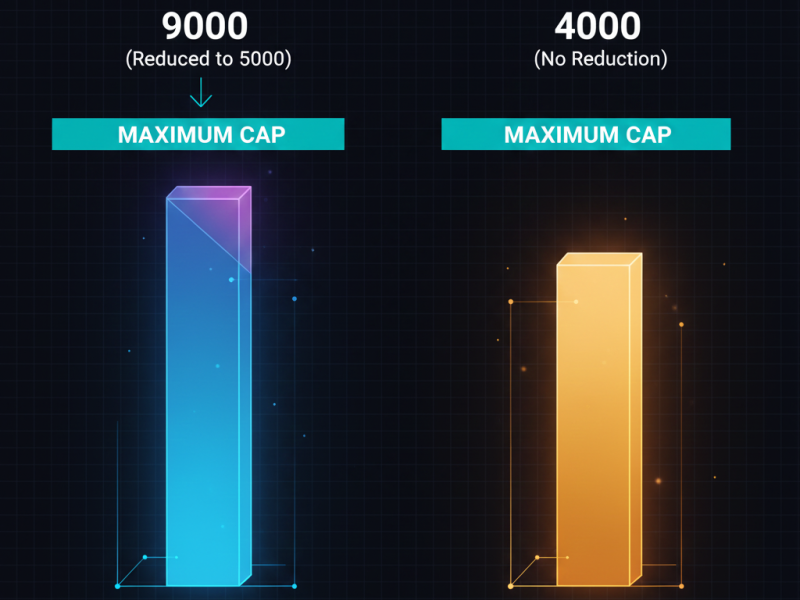
When one spouse earns significantly more, the cap usually doesn’t significantly constrain the calculation.
You earn $150,000 net annually. Your spouse earns $30,000 net annually. The formula calculates $42,500 in maintenance. The 40% cap is $72,000. Adding the spouse’s income and maintenance brings the total to $72,500—just $500 over the cap.
Maintenance is reduced by a minimal $500, from $42,500 to $42,000 annually. When one spouse earns five times what the other earns, the formula yields an amount that doesn’t trigger a significant cap reduction.
The Income Ratio Pattern: When to Expect Cap Impact
Through working with many couples on these calculations, a pattern emerges about when the cap matters most.
Two-to-one income ratio: If you earn roughly double what your spouse earns, expect the cap to reduce your calculated maintenance significantly. The closer your incomes, the more dramatic the cap’s impact.
Three-to-one or higher ratio: When you earn three times or more what your spouse earns, the cap usually doesn’t reduce the calculated amount substantially. The formula tends to produce results that fall within or near the cap.
Near-equal incomes: When incomes are relatively similar, you often won’t have maintenance at all, so the cap becomes moot.
This ratio pattern helps you predict whether the cap will significantly affect your situation before you even run detailed numbers.
Why Understanding This Matters for Financial Planning
Knowing whether the cap will constrain your maintenance amount affects virtually every other financial decision during divorce.
If you’re the receiving spouse and the formula calculates $20,000, but the cap reduces it to $8,000, that $12,000 annual difference fundamentally changes your post-divorce budget.
If you’re the paying spouse and the cap reduces your obligation substantially, you have more disposable income than you initially projected. That affects decisions about property division and whether to keep the marital home.
The cap also affects duration negotiations. If the cap is significantly reducing the monthly amount, the receiving spouse may push for a longer duration to partially compensate.
Common Cap Calculation Mistakes
Several errors repeatedly appear in the cap calculations:
Forgetting to add the receiving spouse’s income. The cap limits the receiving spouse’s total income, not just the maintenance amount. You must add their own income to the maintenance when checking against the cap.
Using gross instead of net income. The cap applies to combined net income. Calculate the forty percent threshold using net figures, not gross.
Stopping after the formula. The most common mistake is simply not checking the cap at all. Always complete the second step.
Rounding errors that accumulate. Minor rounding differences in the percentages can add up. Be precise in calculations, especially when amounts are close to the cap threshold.
How the Cap Interacts With Other Illinois Rules
The forty percent cap is one of several limitations. If you have prior support obligations that take you out of the guideline calculations entirely, the cap doesn’t apply because you’re not using the guideline formula if your combined gross income exceeds $500,000, the same result.
The fifty percent combined obligation limitation (maintenance plus child support cannot exceed fifty percent of the paying spouse’s net income) operates separately from the forty percent income cap.
Verifying Your Calculation: The Final Check
Before finalizing any maintenance agreement, run through this verification checklist:
- Calculate the formula amount correctly using each spouse’s net income
- Determine your combined net income
- Calculate forty percent of that combined figure
- Add the formula-calculated maintenance to the receiving spouse’s net income
- Compare that total to the forty percent threshold
- If it exceeds the threshold, reduce maintenance to bring the receiving spouse’s total down to exactly forty percent
This systematic approach ensures you don’t miss the cap verification step and end up with incorrect expectations.
Using the Cap Knowledge in Mediation
In mediation, understanding the cap helps both spouses approach negotiations realistically.
The receiving spouse who sees the formula calculation might initially hope for that amount, but recognizing the cap applies helps them understand why the actual figure will be lower. This prevents disappointment and unrealistic expectations.
The paying spouse can explain the cap calculation transparently, showing that it’s not an arbitrary negotiating position but a mathematical component of the Illinois calculation.
Both spouses can then discuss whether the capped amount truly makes sense for their situation. Maybe it does, and you agree to stay within the guidelines. Maybe it doesn’t, and you explore non-guideline alternatives.
The key is for both spouses to understand the mechanics, so the conversation focuses on what works rather than arguing about whether the math is correct.
Moving Forward With Accurate Numbers
The forty percent cap isn’t an obscure technicality—it’s a fundamental component that can change outcomes by thousands of dollars annually.
Understanding that the cap prevents the receiving spouse from receiving more than 40% of the combined net income helps you anticipate when it will matter. Knowing the two-step calculation process ensures you arrive at accurate figures.
Whether the cap barely affects your calculation or cuts the formula amount in half, knowing its role helps you plan realistically and make informed decisions about your financial future.
In mediation, this shared understanding transforms the cap into a known factor you incorporate into your planning—just one more piece of the financial puzzle you’re solving together.

FAQs About Illinois Maintenance (Alimony)
About the Authors – Divorce Mediators You Can Trust
Equitable Mediation Services is a trusted and nationally recognized provider of divorce mediation, serving couples exclusively in California, New Jersey, Washington, New York, Illinois, and Pennsylvania. Founded in 2008, this husband-and-wife team has successfully guided more than 1,000 couples through the complex divorce process, helping them reach amicable, fair, and thorough agreements that balance each of their interests and prioritizes their children’s well-being. All without involving attorneys if they so choose.
At the heart of Equitable Mediation are Joe Dillon, MBA, and Cheryl Dillon, CPC—two compassionate, experienced professionals committed to helping couples resolve divorce’s financial, emotional, and practical issues peacefully and with dignity.

Joe Dillon, MBA – Divorce Mediator & Negotiation Expert
As a seasoned Divorce Mediator with an MBA in Finance, Joe Dillon specializes in helping clients navigate complex parental and financial issues, including:
- Physical and legal custody
- Spousal support (alimony) and child support
- Equitable distribution and community property division
- Business ownership
- Retirement accounts, stock options, and RSUs
Joe’s unique blend of financial acumen, mediation expertise, and personal insight enables him to skillfully guide couples through complex divorce negotiations, reaching fair agreements that safeguard the family’s emotional and financial well-being.
He brings clarity and structure to even the most challenging negotiations, ensuring both parties feel heard, supported, and in control of their outcome. This approach has earned him a reputation as one of the most trusted names in alternative dispute resolution.

Cheryl Dillon, CPC – Certified Divorce Coach & Life Transitions Expert
Cheryl Dillon is a Certified Professional Coach (CPC) and the Divorce Coach at Equitable Mediation. She earned a bachelor’s degree in psychology and completed formal training at The Institute for Professional Excellence in Coaching (iPEC) – an internationally recognized leader in the field of coaching education.
Her unique blend of emotional intelligence, coaching expertise, and personal insight enables her to guide individuals through divorce’s emotional complexities compassionately.
Cheryl’s approach fosters improved communication, reduced conflict, and better decision-making, equipping clients to manage divorce’s challenges effectively. Because emotions have a profound impact on shaping the divorce process, its outcomes, and future well-being of all involved.
What We Offer: Flat-Fee, Full-Service Divorce Mediation
Equitable Mediation provides:
- Full-service divorce mediation with real financial expertise
- Convenient, online sessions via Zoom
- Unlimited sessions for one customized flat fee (no hourly billing surprises)
- Child custody and parenting plan negotiation
- Spousal support and asset division mediation
- Divorce coaching and emotional support
- Free and paid educational courses on the divorce process
Whether clients are facing financial complexities, looking to safeguard their children’s futures, or trying to protect everything they’ve worked hard to build, Equitable Mediation has the expertise to guide them towards the outcomes that matter most to them and their families.
Why Couples Choose Equitable Mediation
- 98% case resolution rate
- Trusted by over 1,000 families since 2008
- Subject-matter experts in the states in which they practice
- Known for confidential, respectful, and cost-effective processes
- Recommendations by therapists, financial planners, and former clients
Equitable Mediation Services operates in:
- California: San Francisco, San Diego, Los Angeles
- New Jersey: Bridgewater, Morristown, Short Hills
- Washington: Seattle, Bellevue, Kirkland
- New York: NYC, Long Island
- Illinois: Chicago, North Shore
- Pennsylvania: Philadelphia, Bucks County, Montgomery County, Pittsburgh, Allegheny County
Schedule a Free Info Call to learn if you’re a good candidate for divorce mediation with Joe and Cheryl.