When you’re trying to understand what child support will look like, you might focus primarily on the basic support obligation—the monthly amount calculated using New Jersey’s guidelines. But that basic support number is just part of the picture.
New Jersey’s system recognizes that certain significant expenses fall outside the basic calculation. Health insurance premiums, childcare costs, and unreimbursed medical expenses get added on top, and parents share these costs based on their proportionate incomes.
Understanding how these add-ons work is essential for realistic financial planning. Without accounting for them, you might discover additional costs that significantly impact your budget. Let me walk you through how each category works and how to approach these arrangements cooperatively.
The Concept of Add-On Expenses

From a financial planning perspective, it makes sense that certain costs are treated separately from basic support. The basic obligation covers typical child-rearing expenses, such as food, clothing, housing, and transportation.
But some expenses are substantial, variable, and specific to individual circumstances. Health insurance premiums vary dramatically. Childcare costs depend on children’s ages and parents’ work needs. Medical expenses can be unpredictable and significant.
Rather than building assumptions about these variable costs into the basic calculation, New Jersey treats them as add-ons. Each parent contributes proportionately based on their income share, the same principle that underlies basic support.
This approach provides transparency and fairness. You’re looking at actual costs and dividing them proportionately.
Health Insurance Premiums
Health insurance for children is typically the most straightforward add-on. If one parent carries health insurance for the children, the premium cost attributable to the children gets allocated between both parents.
The key phrase is “attributable to the children.” If you’re on a family plan, you need to determine what portion of the premium is for the children versus yourself or other family members. Many employer plans provide breakdowns showing the costs of individual versus family coverage.
Once you’ve identified the children’s premium cost, both parents share that expense based on their proportionate incomes. If one parent earns 65% of the combined income and the other earns 35%, they split the premium 65-35.
In practice, the parent who carries the insurance receives a credit in the child support calculation for the portion that the other parent should pay.
Work-Related Childcare Costs
Childcare expenses are often one of the largest add-ons, particularly for parents with young children. New Jersey includes work-related childcare costs, but the key qualifier is “work-related.”
Childcare is necessary for a parent to work or attend education leading to employment. Daycare while you’re at work, after-school care to cover the gap until you get home, and summer camp that enables you to continue working all qualify.
But childcare chosen primarily for developmental enrichment rather than work necessity doesn’t qualify as a mandatory add-on. A preschool program chosen mainly for educational reasons would typically fall under discretionary expenses covered by basic support.
From a negotiation standpoint, parents sometimes need to discuss borderline situations, like choosing a more expensive daycare for its educational program when a less expensive option would meet the work-related care need.
Like health insurance, work-related childcare costs are divided proportionately by income. Both parents contribute their share, even if only one is incurring the expense.
Unreimbursed Medical Expenses
Unreimbursed medical expenses represent the most unpredictable add-on category. These are healthcare costs not covered by insurance, including co-pays, deductibles, orthodontics, therapy, prescription medications, and specialized treatments.
New Jersey requires parents to share these expenses in proportion to their incomes. However, because these costs can be high and unpredictable, how parents handle them requires clear communication and planning.
Some families experience minimal unreimbursed medical expenses with comprehensive insurance and healthy children. Others face substantial expenses, particularly with chronic conditions, orthodontic treatment, therapy needs, or specialized healthcare.
The first question is what threshold, if any, applies before cost-sharing kicks in. Some parents agree that each will cover small expenses—say, under $100 or $250 per year—on their own, only sharing costs above that threshold. This reduces administrative burden while ensuring high costs are shared.
The second consideration is procedural: Will parents notify each other before incurring non-emergency expenses over a certain amount? How quickly must receipts be submitted? What’s the timeframe for reimbursement? These practical details matter for avoiding conflict.
Calculating Your Total Child Support Picture
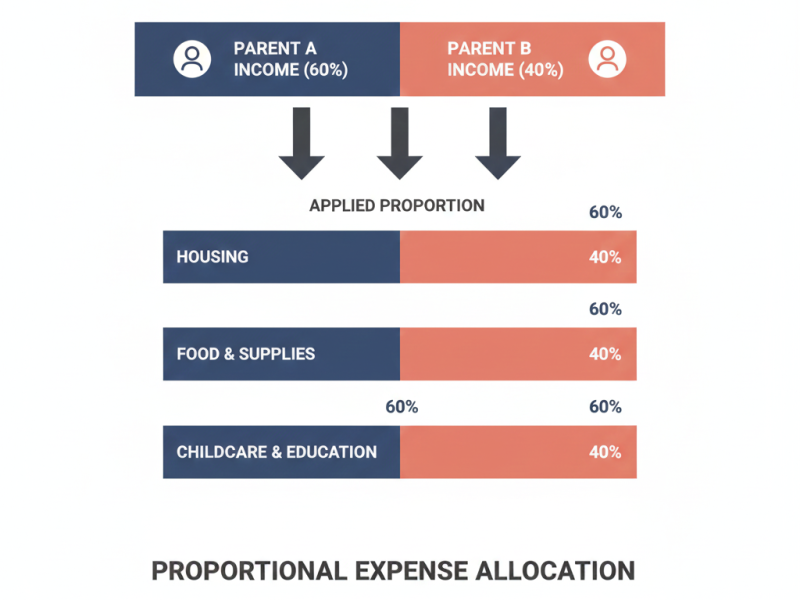
To understand your complete child support situation, you need to look at basic support plus add-ons.
Suppose the basic calculation shows that one parent pays $900 monthly as their proportionate share. Now add the expenses: the children’s health insurance premium is $300 per month, and work-related childcare is $1,200 monthly. The parent responsible for 60% of the combined income contributes 60% of the add-ons ($900), while the other parent contributes 40% ($600).
The calculation adjusts the monthly transfer to account for these cost-sharing obligations, often resulting in a net payment amount that includes both basic support and add-on contributions.
Understanding this complete picture is essential for budgeting. Basic support might seem manageable, but when you factor in significant childcare costs, the monthly obligation increases substantially.
Building Flexibility Into Your Agreement
Your separation agreement should address how these expenses will be handled, including defining what qualifies as reimbursable medical expenses, establishing threshold amounts for cost-sharing, setting timelines for submitting receipts and making reimbursements, and creating a process for discussing significant expenses beforehand.
You might also address what happens if circumstances change. If childcare needs decrease as children age or if one parent loses access to employer-provided insurance, how will you handle the transition?
Building flexibility into your agreement reduces the likelihood of future disputes.
Why These Ongoing Expenses Require Mediation’s Cooperative Approach
Here’s something crucial to understand: unlike basic child support, which gets calculated once and remains relatively stable, these add-on expenses require ongoing cooperation between parents for years. This makes the approach you take to establishing them during your divorce absolutely critical.
In litigation, these add-ons often become battlegrounds. Attorneys argue over whether specific expenses qualify, fight about documentation requirements, and dispute reimbursement timelines. Parents leave court with rigid language about these expenses but without the cooperative relationship needed to manage them day to day.
The problem is that these expenses don’t remain static. Insurance options change when parents switch jobs. Childcare needs evolve as children age. Medical situations arise that require quick decisions and coordination. When you’ve established these arrangements through an adversarial process, every change becomes a potential fight.
Litigation also tends to create overly complicated mechanisms for handling these expenses, often with rigid timelines and penalty provisions that sound good in court but create ongoing friction in real life. You end up with procedures designed to protect against the worst-case scenario rather than to facilitate everyday cooperative parenting.
The ongoing administrative burden also gets harder when parents haven’t built a foundation of cooperation. One parent delays submitting receipts as a form of control or retaliation. The other drags their feet on reimbursements. Minor disagreements about whether an expense qualifies escalate into major conflicts because you don’t have the communication framework to resolve them.
Mediation creates something fundamentally different. You and your co-parent work together to establish these cost-sharing arrangements, focusing on what actually works in practice. You can discuss which threshold amounts make sense for your situation, create reasonable timelines that work for both of you, and establish communication patterns to manage these expenses cooperatively.
In mediation, you can also address the “gray areas” that inevitably arise. What about sports equipment or activity fees? How do you handle situations where one parent thinks an expense is necessary and the other disagrees? Building in processes for discussing and resolving these questions ahead of time saves enormous conflict down the road.
The cooperative foundation you build in mediation carries forward into your co-parenting relationship. When you’ve worked together to create these arrangements, you’re more likely to handle them cooperatively going forward. You’ve established patterns of sharing information, discussing concerns, and making joint decisions about your children’s needs.
When Circumstances Differ from Expectations
Life doesn’t always follow the plan you made during divorce. Children develop unexpected medical needs. Childcare costs increase. Insurance situations change.
Your agreement should anticipate changes and include mechanisms to address them. Some parents agree to review expenses annually and adjust if needed. Others build in provisions for renegotiating if expenses change significantly.
The goal is to reduce conflict when reality deviates from expectations.
The Importance of Clear Communication
More than with basic support, these add-on expenses require ongoing communication between parents. You need to share information about insurance changes, discuss childcare arrangements, and coordinate regarding medical care.
Approaching this communication cooperatively serves both your interests. When you keep each other informed and handle reimbursements promptly, you reduce friction and build trust.
Moving Forward with Expert Guidance and Cooperation

Health insurance, childcare costs, and unreimbursed medical expenses can significantly impact your total child support picture. Understanding how these add-ons work allows you to plan realistically and avoid unwelcome financial surprises. In some situations, these additional expenses may even require you to calculate a fair deviation from the standard guideline amount so the final support arrangement accurately reflects your family’s real financial obligations.
When negotiating your agreement, pay careful attention to how these expenses will be handled. The difference between arrangements that work smoothly for years and those that create ongoing conflict often comes down to how thoughtfully you establish them initially.
Working with a divorce mediator who understands both the financial mechanics and the practical challenges of managing these expenses makes an enormous difference. I can help you think through realistic thresholds, create workable procedures for documentation and reimbursement, and establish communication patterns that will serve you well in the long term.
We can analyze your insurance options together, consider different approaches to handling medical expenses, and create straightforward but flexible arrangements for childcare costs as your children’s needs evolve. The goal is to establish systems that work in real life, not just on paper.
These ongoing shared expenses are precisely the kind of issue where the cooperative foundation you build in mediation pays dividends for years. You’re not just creating a calculation—you’re establishing a framework for working together on your children’s ongoing needs. That framework, built on transparency and cooperation rather than adversarial positioning, makes an enormous difference in how smoothly these arrangements function over time.
You don’t need rigid court-ordered provisions designed for worst-case scenarios. You need practical, workable arrangements established through collaboration and designed for the real-world cooperation you’ll need as co-parents. That’s what mediation provides—the opportunity to build these systems together with expert guidance, creating agreements that actually work for your family’s specific circumstances and your ongoing relationship.

FAQs About New Jersey Child Support
About the Authors – Divorce Mediators You Can Trust
Equitable Mediation Services is a trusted and nationally recognized provider of divorce mediation, serving couples exclusively in California, New Jersey, Washington, New York, Illinois, and Pennsylvania. Founded in 2008, this husband-and-wife team has successfully guided more than 1,000 couples through the complex divorce process, helping them reach amicable, fair, and thorough agreements that balance each of their interests and prioritizes their children’s well-being. All without involving attorneys if they so choose.
At the heart of Equitable Mediation are Joe Dillon, MBA, and Cheryl Dillon, CPC—two compassionate, experienced professionals committed to helping couples resolve divorce’s financial, emotional, and practical issues peacefully and with dignity.

Joe Dillon, MBA – Divorce Mediator & Negotiation Expert
As a seasoned Divorce Mediator with an MBA in Finance, Joe Dillon specializes in helping clients navigate complex parental and financial issues, including:
- Physical and legal custody
- Spousal support (alimony) and child support
- Equitable distribution and community property division
- Business ownership
- Retirement accounts, stock options, and RSUs
Joe’s unique blend of financial acumen, mediation expertise, and personal insight enables him to skillfully guide couples through complex divorce negotiations, reaching fair agreements that safeguard the family’s emotional and financial well-being.
He brings clarity and structure to even the most challenging negotiations, ensuring both parties feel heard, supported, and in control of their outcome. This approach has earned him a reputation as one of the most trusted names in alternative dispute resolution.

Cheryl Dillon, CPC – Certified Divorce Coach & Life Transitions Expert
Cheryl Dillon is a Certified Professional Coach (CPC) and the Divorce Coach at Equitable Mediation. She earned a bachelor’s degree in psychology and completed formal training at The Institute for Professional Excellence in Coaching (iPEC) – an internationally recognized leader in the field of coaching education.
Her unique blend of emotional intelligence, coaching expertise, and personal insight enables her to guide individuals through divorce’s emotional complexities compassionately.
Cheryl’s approach fosters improved communication, reduced conflict, and better decision-making, equipping clients to manage divorce’s challenges effectively. Because emotions have a profound impact on shaping the divorce process, its outcomes, and future well-being of all involved.
What We Offer: Flat-Fee, Full-Service Divorce Mediation
Equitable Mediation provides:
- Full-service divorce mediation with real financial expertise
- Convenient, online sessions via Zoom
- Unlimited sessions for one customized flat fee (no hourly billing surprises)
- Child custody and parenting plan negotiation
- Spousal support and asset division mediation
- Divorce coaching and emotional support
- Free and paid educational courses on the divorce process
Whether clients are facing financial complexities, looking to safeguard their children’s futures, or trying to protect everything they’ve worked hard to build, Equitable Mediation has the expertise to guide them towards the outcomes that matter most to them and their families.
Why Couples Choose Equitable Mediation
- 98% case resolution rate
- Trusted by over 1,000 families since 2008
- Subject-matter experts in the states in which they practice
- Known for confidential, respectful, and cost-effective processes
- Recommendations by therapists, financial planners, and former clients
Equitable Mediation Services operates in:
- California: San Francisco, San Diego, Los Angeles
- New Jersey: Bridgewater, Morristown, Short Hills
- Washington: Seattle, Bellevue, Kirkland
- New York: NYC, Long Island
- Illinois: Chicago, North Shore
- Pennsylvania: Philadelphia, Bucks County, Montgomery County, Pittsburgh, Allegheny County
Schedule a Free Info Call to learn if you’re a good candidate for divorce mediation with Joe and Cheryl.