The most difficult sentence you might say in your New York divorce negotiations is: “We need to talk about spousal maintenance.” You’re discussing money with someone you once loved, someone who is now the co-parent of your children. The stakes feel impossibly high because this conversation could either pave the way for functional co-parenting or create wounds that never heal.
I know this from both sides. As a mediator, I’ve sat with countless couples at this crossroads. But I also know it as a child of divorce. When I was fifteen, I lost contact with my father after my parents’ contentious divorce. The adversarial process didn’t just divide their assets—it destroyed their ability to co-parent and cost me a relationship with my dad. That experience is why I founded Equitable Mediation Services: to help families avoid the damage that litigation inflicts on co-parenting relationships.
How you have this conversation matters as much as what you ultimately decide. The couples who navigate this successfully have a different approach to the conversation itself—one that litigation actively undermines.
Why Litigation Makes This Conversation Toxic
When you’re discussing spousal maintenance in New York, you’re not just talking about formulas and income caps. You’re talking about fairness, sacrifice, value, and worth. You’re talking about fear—financial insecurity on one side and fear of being taken advantage of on the other.
For co-parents, there’s additional complexity. Every harsh word, every accusation, every moment of contempt becomes part of the foundation of your co-parenting relationship. The person you’re calling selfish today is the same person you’ll need to communicate with about your child’s school performance next month.
The traditional adversarial approach is particularly damaging for co-parents. When attorneys position maintenance as a battle to be won, they’re teaching you to see your co-parent as an opponent. That mindset might help you fight harder in the short term, but it makes successful co-parenting nearly impossible. I watched this happen with my own parents. Once the attorneys got involved, every conversation became a fight. By the time their divorce was final, they couldn’t speak civilly to each other—and that hostility cost me my relationship with my father.
The First Principle: Separate Positions from Interests
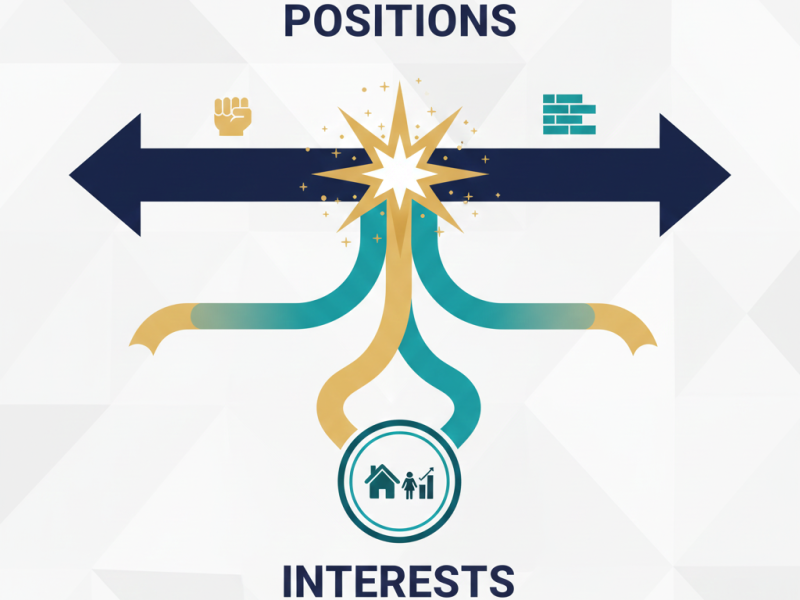
In my training at Harvard’s Program on Negotiation, I learned a distinction that transforms difficult conversations: the difference between positions and interests. Your position is what you say you want. Your interest is what you want.
One spouse might take the position: “I need $4,000 per month for five years.” The other: “I’ll pay $1,500 for two years, maximum.” These positions feel mutually exclusive.
But underneath are interests. The spouse requesting maintenance might need housing stability for the children, time to complete a degree, or recognition of homemaker contributions. The spouse facing payments might need to maintain a home where children can visit, or worry about inflexible payment terms.
When you shift from positions to interests, you stop debating numbers and start problem-solving. The requesting spouse might not need $4,000 monthly—they need $2,000 plus a plan to complete a nursing degree. The paying spouse might not oppose support—they’re worried about inflexibility.
We guide couples through this reframing by asking, “What would this maintenance allow you to do?” What concerns do you have? What does fairness look like here? These questions move from demands to dialogue.
Reframing Maintenance as a Shared Problem

One of the most powerful strategies from my training is reframing. Instead of treating maintenance as something one person takes from the other, successful co-parents frame it as a shared problem requiring a shared solution.
The shared problem becomes: “How do we ensure both of us can maintain stable homes for our children while acknowledging the financial realities of supporting two households?” Notice how different this feels from “How much do I have to pay you?”
This reframing changes the fundamental dynamic. When maintenance is a shared problem, you’re both on the same side of the table. You become collaborators rather than adversaries. This shift is essential for co-parents because it establishes collaborative problem-solving that will serve you in every future co-parenting decision.
New York’s maintenance guidelines actually support this approach. The state provides formulas—currently using a $228,000 income cap and duration ranges based on marriage length—but explicitly allows deviation when appropriate. This flexibility enables couples to work together toward solutions that make sense for their circumstances.
Having Honest Conversations About Needs and Capabilities
The maintenance conversation requires vulnerable honesty. The person seeking maintenance must be honest about financial needs without shame. The person paying must be honest about capabilities without guilt or resentment.
During my training at Northwestern, I learned about “transparent disclosure”—the idea that in relationship-preserving negotiations, clarity creates better long-term outcomes than strategic ambiguity.
We create space for these conversations by establishing ground rules that prevent information from being weaponized. We discuss financial capabilities separately from what anyone “deserves.” We focus on the present and future rather than litigating the past.
The Mediation Process: Creating Structure for Difficult Conversations
Maintenance conversations often go badly because couples try having them in unstructured ways—late-night texts, kitchen arguments, tense parking lot discussions. The mediation process provides a structure that makes difficult conversations possible.
We use interest-based negotiation to dig beneath positions. Rather than starting with numbers, we start with understanding: What’s most important to each of you? What concerns keep you up at night?
We engage in “reality-testing” of assumptions. People arrive with untested beliefs that we examine together using actual data and scenarios. This isn’t about proving someone wrong—it’s about working from the same accurate information.
Most importantly, mediation encourages generating multiple options before committing to solutions. Instead of negotiating between $4,000 and $1,500, we explore: What if maintenance decreases over time? What if we structure it for specific expenses? What if we combine it with unequal property division? What if we include regular check-ins?
By generating options together, you’re not just compromising—you’re creating solutions neither would have come up with on their own. And because you created them together, both of you have ownership.
The Long Game: Maintenance as Co-Parenting Practice

How you negotiate maintenance is practice for co-parenting. If you can discuss money without contempt, listen to concerns, acknowledge different perspectives, and problem-solve together, you’re building skills you’ll use in every co-parenting decision ahead.
Your children are watching. They’re noticing whether you speak respectfully about their other parent. They’re absorbing whether conflicts escalate or resolve. They’re learning what it looks like to handle disagreements. The maintenance conversation is your first opportunity to show them—and yourselves—that you can be divorced partners who still treat each other with dignity.
I wish my parents had been given that opportunity. Instead, the adversarial process taught them to see each other as enemies. That hostility didn’t end when the divorce was final—it became the foundation of their inability to co-parent. That’s what I’m committed to helping you avoid.
This doesn’t mean it will be easy. It means committing to having the conversation in a way that makes future conversations possible. It means pausing when you feel the urge to say something cutting. It means acknowledging when you’re not ready to continue productively.
Choosing the Path That Preserves What Matters Most
The maintenance conversation doesn’t have to destroy your co-parenting relationship. With the right approach, it can strengthen it by establishing that you can work through complex issues together. The key is treating it as problem-solving rather than a battle, focusing on interests rather than positions, and committing to honesty and respect even when it’s hard.
Couples who approach these conversations collaboratively consistently report better long-term co-parenting relationships and greater satisfaction with their agreements than those who fight through attorneys. They’re not just reaching better financial agreements—they’re preserving the ability to co-parent effectively.
This is personal for me. I’ve spent nearly twenty years as a mediator helping families find peaceful paths through divorce, specifically because I know the damage that adversarial divorce inflicts on children. My parents’ litigated divorce didn’t just cost them their relationship—it cost me mine with my father. That’s why I’m committed to offering couples a different path.
How you have this conversation matters. Choose collaboration over combat, understanding over ultimatums, and problem-solving over point-scoring. Your future co-parenting relationship—and your children’s wellbeing—depends on it. That’s not just my professional opinion. It’s my lived experience.

FAQs About Spousal Maintenance in New York
The Mediation Advantage for Maintenance Discussions
Throughout these FAQs, you’ve seen references to mediation as an alternative to litigation. In litigation, attorneys fight over what guidelines produce and argue about how factors apply. You’re spending tens of thousands on adversarial processes that often produce outcomes neither party accepts. For co-parents, this poisons the relationship foundation you need for years ahead.
In mediation, you’re working together to understand what the guidelines say, whether they fit your circumstances, and what alternatives might work better. When you combine that collaborative process with genuine financial expertise—the ability to model scenarios, calculate present values, analyze tax impacts, and structure creative solutions—you get agreements that are both fair and sustainable.
That’s what makes the difference between maintenance arrangements that work and ones that create ongoing conflict.
About the Authors – Divorce Mediators You Can Trust
Equitable Mediation Services is a trusted and nationally recognized provider of divorce mediation, serving couples exclusively in California, New Jersey, Washington, New York, Illinois, and Pennsylvania. Founded in 2008, this husband-and-wife team has successfully guided more than 1,000 couples through the complex divorce process, helping them reach amicable, fair, and thorough agreements that balance each of their interests and prioritizes their children’s well-being. All without involving attorneys if they so choose.
At the heart of Equitable Mediation are Joe Dillon, MBA, and Cheryl Dillon, CPC—two compassionate, experienced professionals committed to helping couples resolve divorce’s financial, emotional, and practical issues peacefully and with dignity.

Joe Dillon, MBA – Divorce Mediator & Negotiation Expert
As a seasoned Divorce Mediator with an MBA in Finance, Joe Dillon specializes in helping clients navigate complex parental and financial issues, including:
- Physical and legal custody
- Spousal support (alimony) and child support
- Equitable distribution and community property division
- Business ownership
- Retirement accounts, stock options, and RSUs
Joe’s unique blend of financial acumen, mediation expertise, and personal insight enables him to skillfully guide couples through complex divorce negotiations, reaching fair agreements that safeguard the family’s emotional and financial well-being.
He brings clarity and structure to even the most challenging negotiations, ensuring both parties feel heard, supported, and in control of their outcome. This approach has earned him a reputation as one of the most trusted names in alternative dispute resolution.

Cheryl Dillon, CPC – Certified Divorce Coach & Life Transitions Expert
Cheryl Dillon is a Certified Professional Coach (CPC) and the Divorce Coach at Equitable Mediation. She earned a bachelor’s degree in psychology and completed formal training at The Institute for Professional Excellence in Coaching (iPEC) – an internationally recognized leader in the field of coaching education.
Her unique blend of emotional intelligence, coaching expertise, and personal insight enables her to guide individuals through divorce’s emotional complexities compassionately.
Cheryl’s approach fosters improved communication, reduced conflict, and better decision-making, equipping clients to manage divorce’s challenges effectively. Because emotions have a profound impact on shaping the divorce process, its outcomes, and future well-being of all involved.
What We Offer: Flat-Fee, Full-Service Divorce Mediation
Equitable Mediation provides:
- Full-service divorce mediation with real financial expertise
- Convenient, online sessions via Zoom
- Unlimited sessions for one customized flat fee (no hourly billing surprises)
- Child custody and parenting plan negotiation
- Spousal support and asset division mediation
- Divorce coaching and emotional support
- Free and paid educational courses on the divorce process
Whether clients are facing financial complexities, looking to safeguard their children’s futures, or trying to protect everything they’ve worked hard to build, Equitable Mediation has the expertise to guide them towards the outcomes that matter most to them and their families.
Why Couples Choose Equitable Mediation
- 98% case resolution rate
- Trusted by over 1,000 families since 2008
- Subject-matter experts in the states in which they practice
- Known for confidential, respectful, and cost-effective processes
- Recommendations by therapists, financial planners, and former clients
Equitable Mediation Services operates in:
- California: San Francisco, San Diego, Los Angeles
- New Jersey: Bridgewater, Morristown, Short Hills
- Washington: Seattle, Bellevue, Kirkland
- New York: NYC, Long Island
- Illinois: Chicago, North Shore
- Pennsylvania: Philadelphia, Bucks County, Montgomery County, Pittsburgh, Allegheny County
Schedule a Free Info Call to learn if you’re a good candidate for divorce mediation with Joe and Cheryl.